New PIT Terminal Adds Important Chapter to Pittsburgh’s Aviation Legacy
Over a century of innovation culminates with the opening of a transformed airport
By Gina Mastrangelo
Published November 10, 2025

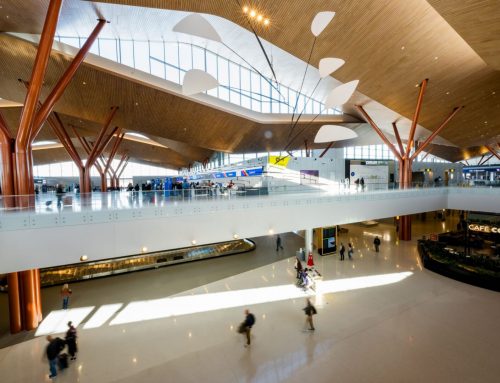
The next chapter in Pittsburgh’s rich aviation legacy starts on Nov. 18 when Pittsburgh International Airport (PIT) opens its modern terminal.
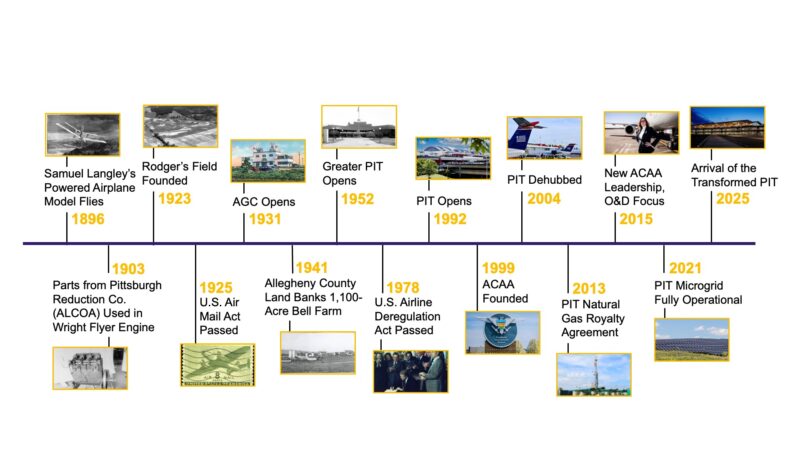
Pittsburgh’s bold step into its next era builds on the legacy of more than a century of innovations that solidified the Steel City’s place in the aviation industry.
Aviation legends in Pittsburgh
Since the dawn of flight, Pittsburgh has played an integral role in aviation.
In 1967, Samuel Langely moved to Pittsburgh to serve as the director of the Allegheny Observatory and a professor of astronomy and physics at the University of Pittsburgh, then called the Western University of Pennsylvania.
He was a pioneer in aviation, making the bold move to test flight rather than simply studying it on paper. In 1896, he successfully flew two steam-powered Aerodomes (the term for early aircraft) over the Potomac River, making history as the first person to conduct a heavier-than-air flight.
Just a few years later in 1903, Wilbur and Orville Wright turned to Pittsburgh to develop their first airplane. The Pittsburgh Reduction Co. – now known as Alcoa – had the answer to overcoming the obstacles the brothers faced with the weight of their aircraft. The company supplied refined light-weight aluminum to help build the historic plane.
Pittsburgh’s humble beginnings in aviation would establish a future where the sky is the limit.
During World War II, thousands of Black pilots, navigators, bombardiers and support personnel were trained at Tuskegee College in Alabama and formed into squadrons to fight in World War II. According to a local historian’s research, the Pittsburgh region sent the largest contingent of Black airmen trained at Tuskegee and enlisted in the U.S. Army Air Force during the war.
Pittsburgh’s first airports set precedent
Before there were airport terminals in Pittsburgh, the region had three airfields created from pockets of vacant farmland: Bettis Field in McKeesport, Mayer Airfield in Bridgeville and Rodgers Airfield in Fox Chapel. Amelia Earhart herself would stop by Rodgers.
In 1925, the U.S. Air Mail Act was passed, requiring the Post Office Department to contract private companies to carry mail by air. In Pittsburgh, Bettis Field became the key mail and passenger center, and later, so did the Allegheny County Airport (AGC).
AGC officially opened in West Mifflin in 1931. AGC was the third largest airport in the country and was a marvel of its time, going on to serve as the region’s primary air hub for two decades until air traffic skyrocketed in the 1950s and modern planes outgrew the facility.
In the early 1940s, Allegheny County acquired the 1,100-acre Bell Farm in Moon Township, which eventually became part of Pittsburgh’s next airport. Several years later, in 1952, Greater Pittsburgh Airport opened.
With a sophisticated air traffic control tower, an improved baggage system and steel framing reflective of the city’s steel industry, Greater Pitt was one of the most innovative airports in the world. It was also one of the first airports to handle jet aircraft thanks to its longer runways.
Then, in 1978, the U.S. Airline Deregulation Act passed, changing the American airline industry by removing some federal control over key aspects of commercial aviation. The Civil Aeronautics Board no longer controlled fares, routes and market entry for airlines, making an impact on cities like Pittsburgh.
Airlines like US Airways took advantage of these new freedoms to expand, resulting in more flights and destinations in Pittsburgh and eventually making Pittsburgh a hub.
In 1992, the city opened its third airport, Greater Pittsburgh International. Dubbed “the airport of the future” by The New York Times, the airport included an innovative X-shaped concourse design, which became a model for airports across the world.
“Through a haze of dust stirred up by earth movers, one of the most innovative major airport terminals in the United States is nearing completion in a clearing twice the size of downtown Pittsburgh,” said a 1992 article from The New York Times. “Scheduled to open in October 1992, the collection of new buildings, their centerpiece an unusually designed X-shape, is being counted on to redefine the 39-year-old Greater Pittsburgh International Airport.”
For a while afterward, aviation thrived in Pittsburgh.
“We had around 21 million passengers,” said Paul Hoback, former chief development officer at PIT. “Most of those were just connecting passengers. There were people who never left the airside terminal.”
On Nov. 2, 1999, the Allegheny County Airport Authority (ACAA) formed. This model redefined what an airport can do for its community, industry and the world. Forming an authority meant PIT and AGC were overseen by a board of directors, giving the airports more freedom to innovate and stretch the idea of what an airport can do beyond serving as a transportation hub.
A once-thriving airport recovers under new leadership
When US Airways filed for bankruptcy in 2004 and pulled its hub from Pittsburgh, the airport was forced to pivot again.
In 2015, Christina Cassotis was chosen to become the ACAA’s CEO by former Allegheny County Executive, Rich Fitzgerald. For Cassotis, becoming CEO was not about running an airport, it was about changing an industry.
Over her tenure at PIT, Cassotis has introduced award-winning, nationally recognized innovations. She spearheaded the construction of a microgrid on PIT’s campus, one that could power the airport through natural gas and thousands of solar panels, increasing the airport’s resiliency and setting a model for the industry.
Cassotis also introduced groundbreaking workforce development initiatives to create jobs and opportunities in the region. In 2023, she and her team opened an on-site childcare center for airport team members, the same year PIT started PIT2Work, a training program that offers a fast-track to careers in the trades. Since then, over 100 people have graduated from the program.
Regardless of what initiative Cassotis embraced, it was clear that she prioritized innovation and progress, refusing to adhere to the limits of what aviation can and should do.
The next era of air travel
The transformed PIT is the culmination of more than a decade of progress and a shift in thinking.
It was Cassotis who disrupted the idea to re-establish a hub in Pittsburgh by encouraging the team to build an airport for Pittsburgh’s current traveler base.
From there, the new PIT was born to create a welcoming experience for every Pittsburgh passenger and to transform air travel to create the airport Pittsburgh deserves.
Follow Blue Sky News for updates on Opening Day.