Airlines Flying Larger Aircraft, Offer More Premium Seats in Pittsburgh
How airlines are responding to consumer trends toward more upscale travel experiences
By Evan Dougherty
Published July 20, 2026
Read Time: 7 mins
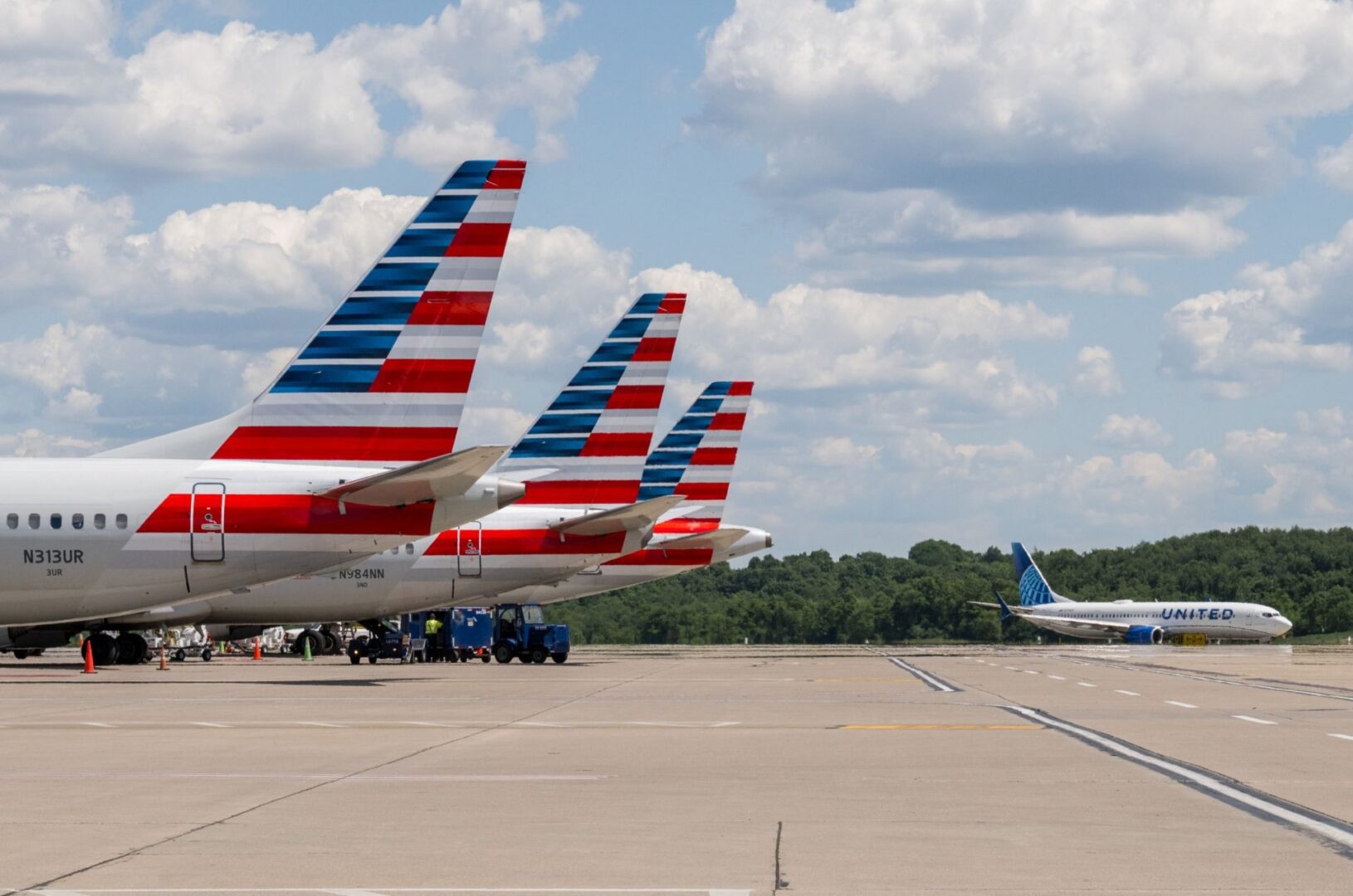
Airlines rushing to cater to premium travelers and evolving aircraft fleet strategies are leading to more capacity offered by carriers at Pittsburgh International Airport from pre-pandemic.
The figures at PIT align with the industry’s post-pandemic trend of focusing less on more flights with lower seat counts in favor of providing more seats — and seating options — on larger aircraft.
From July-December 2026, total seat capacity at PIT is projected to be up 7 percent from the same period in 2019, despite a 6 percent decline in total flights, according to airline traffic data from aviation analytics firm Cirium.
That means more seats available in the market for sale and more options in terms of types of seat experience for passengers. The average number of seats per flight in 2019 was 100 compared to 125 seats today. In addition to more first-class seats, bigger planes allow for more fare classes overall such as more basic economy seats, said Joe Rotterdam, Vice President, Air Service Development at PIT.
During the same period, premium seating availability is also up in key business markets from PIT:
- New York City (JFK, LGA, EWR): Up from 85 percent to 100 percent of all flights
- Washington, D.C. (IAD and DCA): Up from 92 percent to 98 percent
- Chicago-O’Hare (ORD): Up from 97 percent to 100 percent of all flights
Air Canada’s service from PIT to Montreal and Toronto-Pearson had no premium seats available throughout 2019. In 2026, all of Air Canada’s flights to Montreal and Toronto-Pearson have first-class seats available for purchase.
“Pittsburgh is a strong market that has the demand to drive both more overall seats and more business class seats,” Rotterdam said.
From ‘loss-leaders’ to revenue drivers
Since the end of the pandemic, the airline industry has indicated that passengers are willing to invest more in a journey that feels smoother, more comfortable and tailored to their needs, driving higher demand for premium seating options.
Former Delta Air Lines president Glen Haustein said in a quarterly earnings call last year that premium seats at Delta were “loss leaders” 10-15 years ago, with many first-class seats filled by frequent flier upgrades. Now, they are Delta’s highest margin product.
For the first time in company history, Delta’s’ premium cabin revenue outperformed economy cabin revenue in 2025. In the fourth quarter of 2025, Delta reported that its premium revenue rose 9 percent, while its economy revenue dropped 7 percent.
Delta CEO Ed Bastian said the airline’s seat growth in 2026 will primarily focus on expanding premium seating. “Effectively, none of our growth in seats will be in the main cabin; virtually all will be in the premium sector.”
Like Delta, American Airlines is expanding premium capacity across its fleet of aircraft in response to increased demand from high-spending travelers. American has begun adding more first-class seats to its Airbus A319 and A320 aircraft as part of a cabin upgrade program, with each first-class seat redesigned with privacy wings, a new feature increasing in popularity with other carriers.
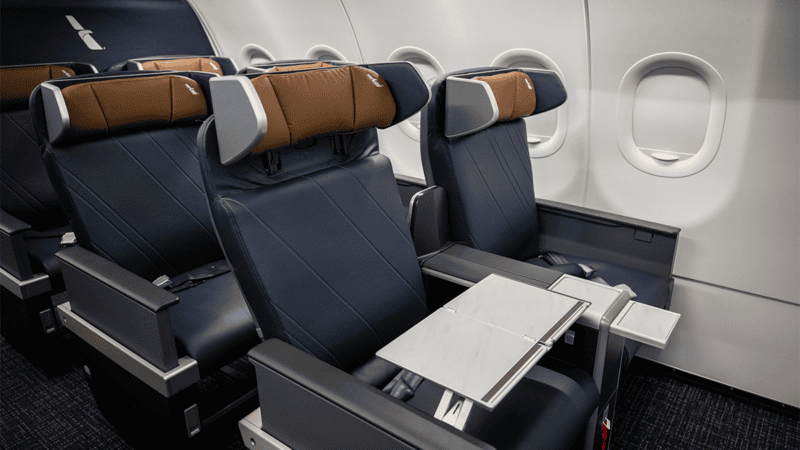
American is retrofitting its Airbus A319 and A320 aircraft with more first-class seats featuring privacy wings, additional storage and two beverage trays. (Courtesy of American Airlines)
Even despite recent headwinds from rising fuel costs, United Airlines says affluent travelers remain the most resilient customer group and continue to spend on travel. Airlines like United have acknowledged premium travel demand has helped airlines absorb costs incurred by high fuel prices.
“I expected a bigger elasticity effect than we’ve seen so far,” United CEO Scott Kirby said at the International Air Transport Association’s Annual General Meeting & World Air Transport Summit in June. “I’ve been a little surprised that we haven’t seen more of that so far.”
In response to consumers and competition from network carriers, low-cost and ultra-low-cost carriers are also investing in new premium seats, in-flight connectivity and bundled fares that are replacing al-la-carte offerings.
Southwest Airlines reported that demand for its extra legroom seating, which it introduced in 2024, has “surpassed expectations,” while also stating that customers purchasing premium upgrades on Southwest flights have risen from 25 percent to 60 percent in the past year. Southwest also acknowledged that it plans to introduce lounges in the future — a first for the airline.
“Our existing customer base, and the new customers we are attracting, want and are willing to pay for our new products and our product attributes,” Southwest CEO Bob Jordan said during the airline’s first quarter earnings call in April 2026. “In other words, they love the Southwest product.”
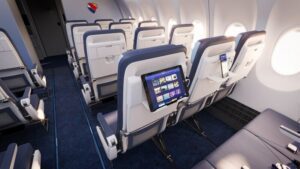
Introduced in 2024, Southwest’s extra legroom seating, located at the front of each aircraft and in the emergency exit rows, offers up to five extra inches over standard seating. (Courtesy of Southwest Airlines)
JetBlue Airways has also capitalized on the industry’s premium travel boom, recently adding its first-ever BlueHouse lounges at New York-JFK and Boston. JetBlue president Marty St. George said the airline plans to introduce domestic first-class seating to most of its fleet beginning later this year.
Additionally, airlines are investing in upgrading in-flight wi-fi from legacy land-based systems to high-speed, satellite-based hardware. Carriers have also made wi-fi free-of-charge thanks to increased bandwidth and lower retrofit costs provided by newer systems such as SpaceX’s Starlink and Amazon’s LEO.
Numerous U.S. carriers, along with Aer Lingus and British Airways, are currently retrofitting Starlink wi-fi to their aircraft. Frontier Airlines announced July 14 it plans to introduce in-flight wi-fi powered by Starlink starting in 2027, becoming the U.S.’ first budget carrier to offer it to passengers. Allegiant Air’s new Boeing 737 MAX 8-200 aircraft are being delivered “pre-wired” for wi-fi hardware as the carrier explores adding in-flight connectivity for customers.
‘Upgauging’ to bigger jets
Meanwhile, U.S. airlines are moving to larger aircraft types to offer greater flexibility. Carriers and industry experts cite that larger planes enable more premium seats up front for high-spending travelers and provide more total seats to reduce airlines’ cost per average seat mile. Others have noted pilot and air traffic controller shortages and lack of infrastructure at major hubs where higher capacity aircraft can carry more passengers while using less real estate.
“The country is just not building a lot more runways, and that’s just going to cause us to need to upgauge our aircraft to respond to growing demand,” United’s Chief Commercial Officer Andrew Nocella said in 2023.
Delta and other airlines have adopted an “upgauging” strategy to replace older aircraft with newer types that offer more seats and use less fuel. Until the pandemic, Delta primarily operated 150-seat McDonnell Douglas MD-88s on its Pittsburgh-Atlanta route. Today, Delta primarily serves the route with larger aircraft such as 180-seat Boeing 737-900ERs and 191-seat Airbus A321s, which replaced the MD-88s while offering 20-27 percent more seats per flight.
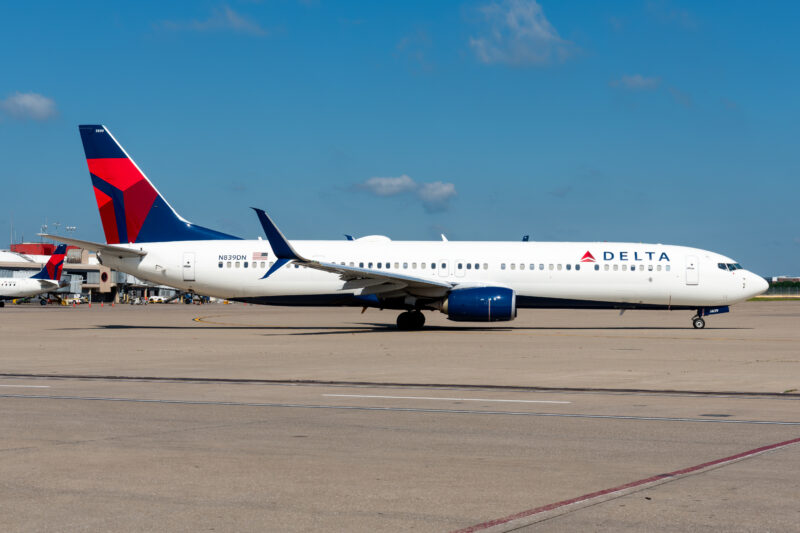
A Delta Boeing 737-900ER taxis out of the ramp at PIT bound for Atlanta on June 7, 2026. (Photo by Evan Dougherty)
In 2025, JetBlue retired its 100-seat Embraer E190 aircraft, which have been replaced by 140-seat Airbus A220-300s. Southwest Airlines is currently phasing out 137-seat Boeing 737-700 aircraft for 175-seat Boeing 737 MAX 8s, while United plans to phase out its smaller A319s and A320s entirely by 2030, replaced by newer, larger Airbus A321neo and various Boeing 737 MAX models.
Major U.S. carriers are opting for the A321neo and 737 MAX 10, the highest capacity variants of popular Airbus A320 family and Boeing’s 737 series, which feature between 180-200 seats in a typical layout.
The A321neo is Airbus’s most popular narrowbody aircraft, now making up 72 percent of Airbus’ total orders of the A320 family. The Boeing 737 MAX 10, developed in response to the A321neo, has also grown in popularity, securing major orders from Alaska Airlines, American, Delta and United.
In regional fleets, Air Canada, American and Delta are phasing out 50-seat, single-class aircraft, such as the CRJ-200 and E145, with larger regional jets, such as the Embraer E175 and CRJ-900 in dual-class layouts. In 2024, American placed an order for 90 additional E175 aircraft that will upgrade flights operated by 50-seat aircraft, which it expects to phase out entirely by the end of the decade.
United also continues to expand its E175 fleet and CRJ-550, a modified CRJ-700 reduced from 70 to 50 total seats but refurbished with more first-class seating and a luggage closet that negates gate-checked baggage. Introduced in 2019, United’s CRJ-550s have replaced single-class 50 seaters to offer a premium product in smaller markets.
Inspired by the CRJ-550 program, United will also introduce the CRJ-450, a modified 41-seat version of the 50-seat CRJ-200. The CRJ-450 will be modified to add five first-class seats, a luggage closet, larger overhead bins and Starlink wi-fi onboard. Scheduled to enter service later this year, the CRJ-450 will primarily serve small communities in United’s network, offering a consistent premium product to travelers across more destinations.
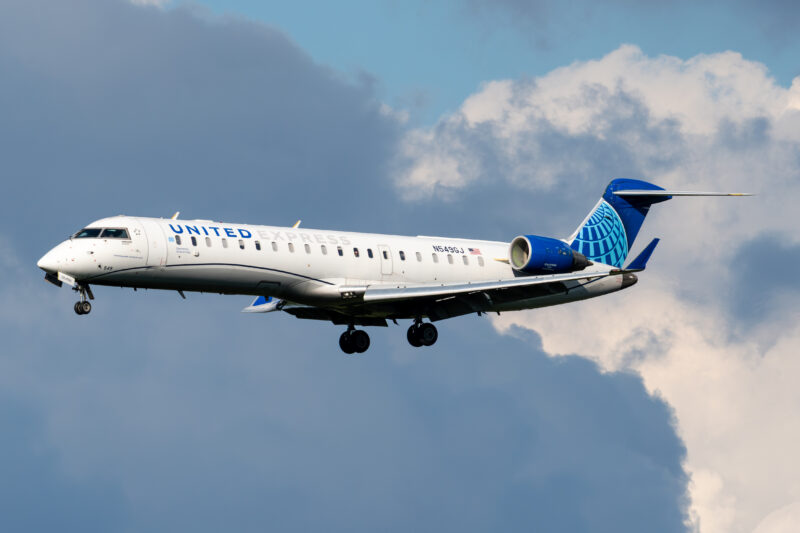
A United CRJ-550 arrives at PIT from Newark on June 19, 2026. The CRJ-550 is a modified CRJ-700 with 50 seats in a two-class layout that has enabled United to replace single-class regional jets while offering a more premium onboard experience. (Photo by Evan Dougherty)