Breeze Builds on Pittsburgh Success with Its Largest Schedule Yet
Airline’s point-to-point strategy has fueled steady growth, expanded nonstop service across its PIT network
By Evan Dougherty
Published November 9, 2026
Read Time: 5 mins
Editor’s note: This is the latest in a series of stories profiling airlines at Pittsburgh International Airport. The previous edition featured Southwest Airlines, which can be read here.
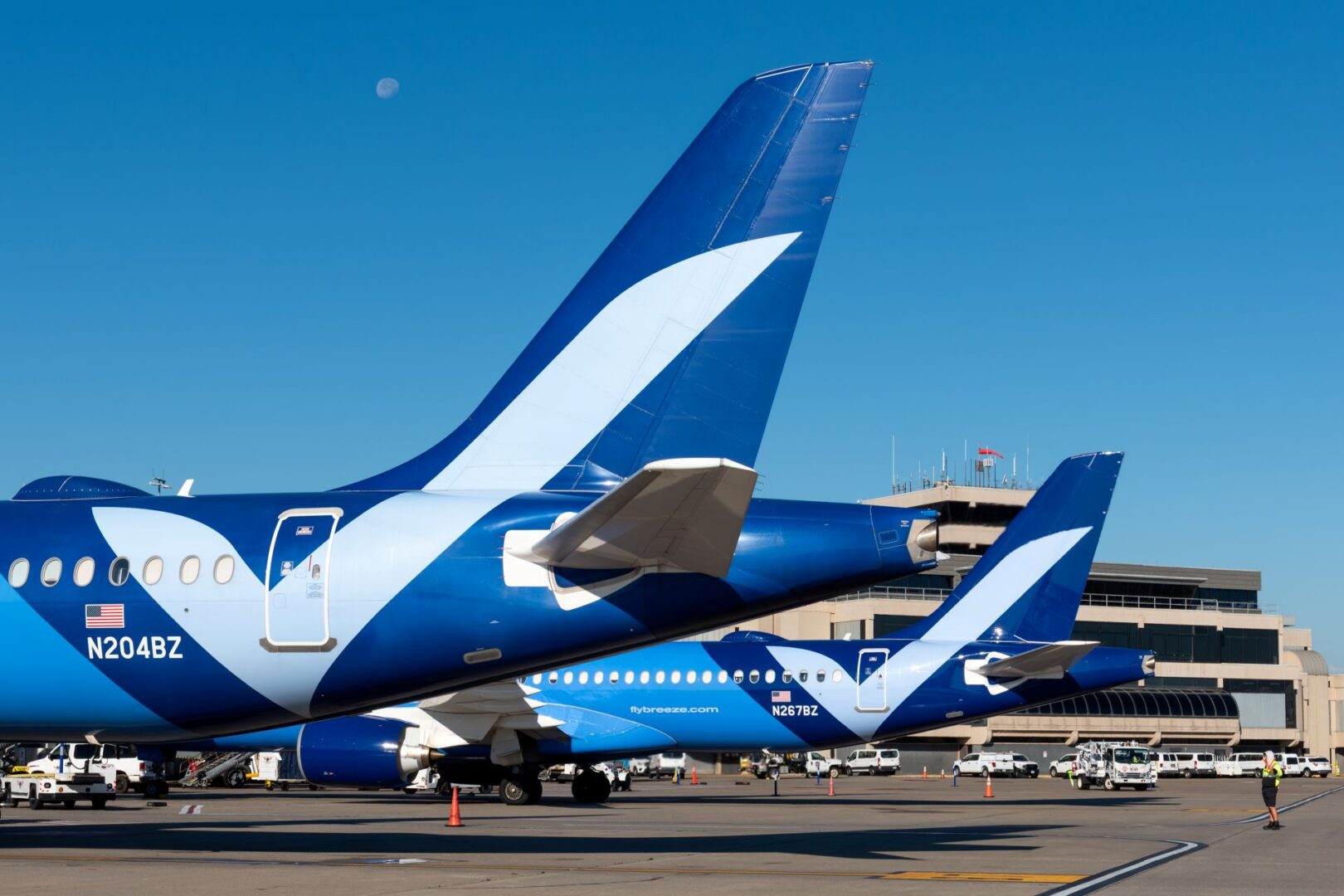
Breeze Airways marked five years of service at Pittsburgh International Airport this summer, but the milestone is just one measure of the airline’s continued growth in the market.
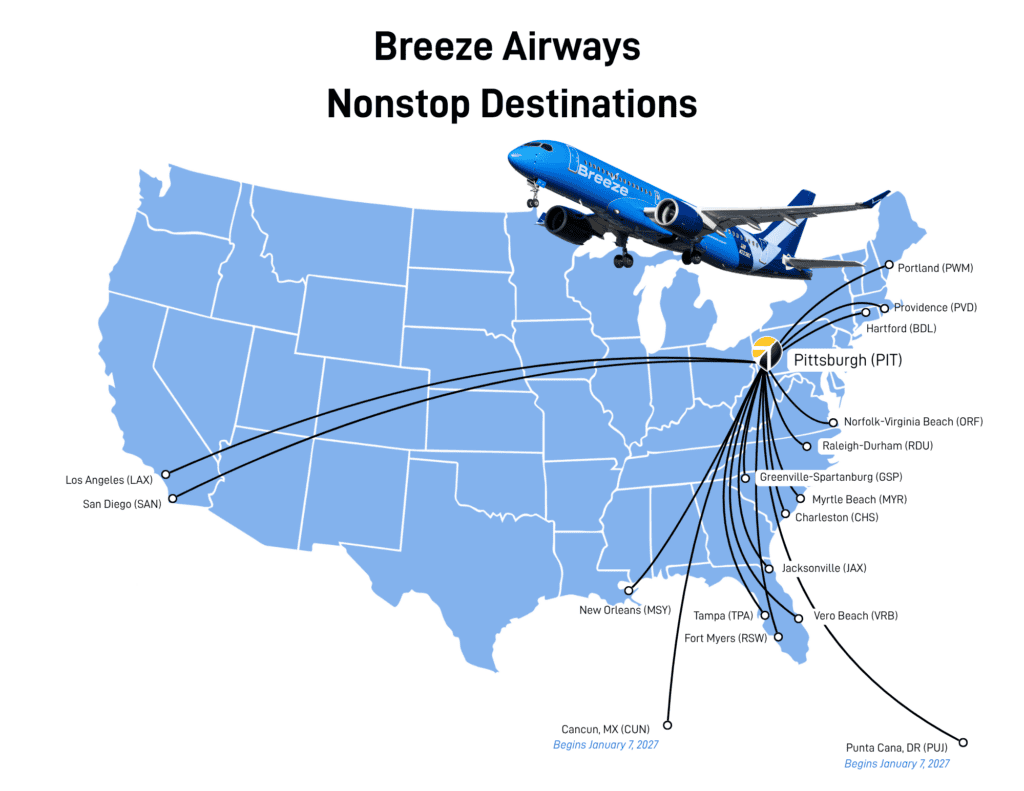
In January 2027, Breeze will launch seasonal nonstop service to Cancun, Mexico, and Punta Cana, Dominican Republic, the airline’s first international service from Pittsburgh, adding capacity and expanding PIT’s nonstop options to the Caribbean.
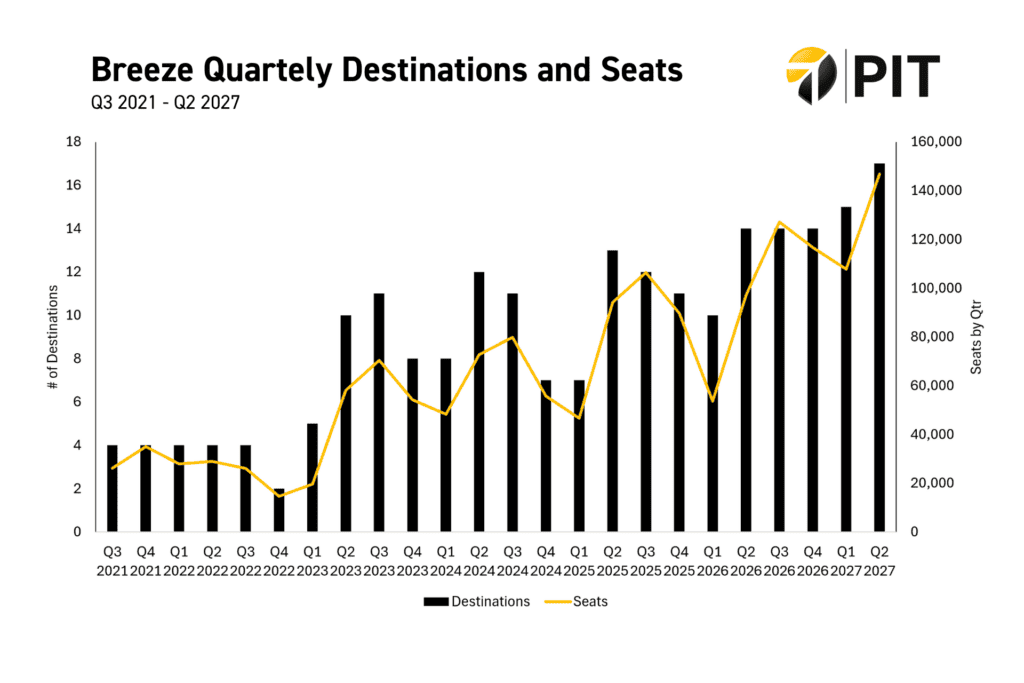
Cancun and Punta Cana are part of a multi-city expansion Breeze announced earlier this year, which also included Pittsburgh’s first nonstop service to Vero Beach, Fla. That route launched in October with seasonal service. The expansion brings Breeze up to 17 nonstop destinations from PIT, second only to Southwest Airlines’ 25.
“Breeze continues to invest in Pittsburgh. They continue to grow and we’re really excited to continue to build on this strong partnership into the future,” said Joe Rotterdam, Vice President of Air Service Development at PIT.
The additions are part of a broader expansion planned for Pittsburgh heading into 2027.
In the first half of next year, Breeze will increase its scheduled seats at PIT by 69 percent year-over-year, according to data from aviation analytics firm Cirium, giving the airline its largest schedule ever at the airport. By next summer, Breeze plans to operate up to nine daily departures, another record for the carrier in Pittsburgh.
Source: Cirium/Diio MI
Connecting Underserved Markets
Breeze began service in Pittsburgh in July 2021 as one of the airline’s first 16 cities when it commenced operations. Founded by aviation entrepreneur David Neeleman, who also created Morris Air, WestJet, JetBlue Airways and Azul Linhas Aéreas, Breeze was established to connect underserved markets that lack nonstop service.
Breeze’s arrival was significant for PIT and its air service strategy prioritizing origin-and-destination traffic. The airline operates a “point-to-point” network model, connecting markets with nonstop flights that might otherwise require travelers to connect through major hubs. As a result, Breeze has brought more competition and new nonstop options to Pittsburgh, particularly in markets that had lost service when US Airways closed its hub beginning in 2004.
Breeze first entered Pittsburgh with service to Charleston, S.C.; Hartford, Conn.; Norfolk-Virginia Beach, Va.; and Providence, R.I. All four markets were once legacy US Airways routes when Pittsburgh was a hub.
Rhett Morgan, senior director of business development for industry consulting firm Ailevon Pacific, said Breeze has filled a void of entering business and leisure markets that were either unserved or underserved.
“Breeze’s business model fits Pittsburgh’s demand profile. Not only that their business model is primarily less-than-daily service, but they also offer such a good product that caters toward both the leisure and the business traveler. And the markets that they’ve chosen fit both of those segments; Pittsburgh has some markets that heavily skew more toward business and others that have a leisure component, which is a reason why they’ve been so successful and been able to grow in Pittsburgh.”
Breeze combines a pricing structure similar to budget carriers with premium onboard amenities that appeal to travelers. It also offers free family seating onboard. For comparison, in July 2026, Breeze’s average one-way fare from PIT was $128 compared to the $214 average of all carriers combined at the airport, according to Cirium.
Additionally, Breeze has also focused on delivering consistent, reliable operations, often performing strongly compared to larger network and budget carriers. In October, Breeze ranked second only to Delta Air Lines in on-time performance among North American carriers with an 85.45 percent score, according to OAG data.
“It’s very impressive to see a relatively new carrier deliver a strong operation consistently. Five years is a very short timeframe in an airline’s life cycle,” said Morgan. “That’s hard to do in this business, especially for a younger carrier, but Breeze has done a really good job at keeping a strong operation in terms of reliability, which only helps influence their growth and appeal to customers in Pittsburgh.”
Breeze initially began service at PIT with Embraer E190 and E195 aircraft with 108-118 seats but has since transitioned entirely to the Airbus A220-300, now the backbone of its fleet. Featuring 137 seats in three classes, Breeze’s A220s offer an upgraded passenger experience with modern amenities valued by customers, including first-class and more extra legroom seating, high-speed Wi-Fi and in-seat power.
The A220 also offers operational advantages, including lower fuel consumption and right-sized capacity, for markets Breeze serves. Its 2-3 seating configuration, quieter cabin, larger windows and expanded overhead bins have also made it a popular aircraft with passengers.
Source: Cirium/Diio MI
Building Demand, Expanding Service
PIT and Breeze have worked together introducing nonstop service to underserved markets, often starting with less-than-daily schedules concentrated around peak travel days. In multiple cases, the new routes have developed and stimulated demand, leading Breeze to increase service.
Charleston, one of Breeze’s original four markets from Pittsburgh, has become the airline’s largest market at PIT, and now operates up to daily in the summer. Providence, another original Breeze market, will expand to five times weekly service next summer, the largest nonstop flight schedule Breeze has ever offered on the route.
In 2023 the airline launched nonstop service to New Orleans; Orange County, Calif.; Jacksonville, Fla.; Portland, Maine; Fort Myers, Fla.; Raleigh-Durham, N.C.; and Tampa, Fla. Most of the markets initially launched with seasonal, twice-weekly service.
Breeze eventually shifted its Orange County service to Los Angeles to expand its presence in the broader Los Angeles market. Meanwhile, Fort Myers, Raleigh-Durham and Tampa have all transitioned to year-round service, with each market scheduled to operate four times a week in 2027.
The airline has also extended service in several seasonal markets. New Orleans, which typically operates during the fall and winter, will see its season extended through the summer months in 2027 for the first time. Seasonal service to Jacksonville and Portland will also resume earlier in March rather than their previously scheduled May resumptions.
In 2024, Breeze launched nonstop service to San Diego, one of Pittsburgh’s largest unserved markets at the time. The following year, the airline introduced seasonal service to Greenville-Spartanburg, S.C., a market that had not been served since 2005 by US Airways. Strong demand has since prompted Breeze to upgrade the route to year-round and with a third weekly flight for next summer.
In 2026, Breeze entered the Pittsburgh-Myrtle Beach market following Spirit Airlines’ shutdown, joining Allegiant Air and Southwest Airlines on the route. In response to strong demand, Breeze has quickly expanded Myrtle Beach from twice weekly seasonal flights to year-round service, with service being offered up to daily for Summer 2027.
The expanded service is a clear indicator of healthy route performance, said Morgan.
“That’s a direct reflection of how well Breeze is doing in Pittsburgh from a profitability perspective. They’ve found a market that has responded here in Pittsburgh, and they’re growing accordingly.”