Allegheny County Airport Nears Second Century with Busy Future
Private business flights, medical transports and aviation schools power AGC as one of the state’s busiest airports
By Blue Sky Staff
Published September 14, 2026
Read Time: 6 mins

Editor’s Note: This is the second of two stories celebrating the 95th anniversary of Allegheny County Airport, the region’s first major commercial airport. Part One can be read here. This story has been updated to reflect the celebration details.
Allegheny County Airport’s history as an aviation pioneer is well documented – from hosting Amelia Earhart to building one of the first lighted and hard surface airfields.
Less well known is the airport’s mission today as a key role in medical transports, private business flights, aviation education and private flying among other uses. The airport turned 95 this month and Allegheny County Airport Authority (ACAA) officials plan to celebrate the milestone this week. ACAA operates both Pittsburgh International Airport and Allegheny County Airport (AGC).
“AGC continues to be a key community asset and one of the busiest airports in the state,” said Sara Innamorato, Allegheny County Executive. “From its storied history to its present day importance, AGC has been an economic generator for the Mon Valley and beyond for more than nine decades. It’s such a critical piece of infrastructure in Allegheny County and we are extremely proud of it.”
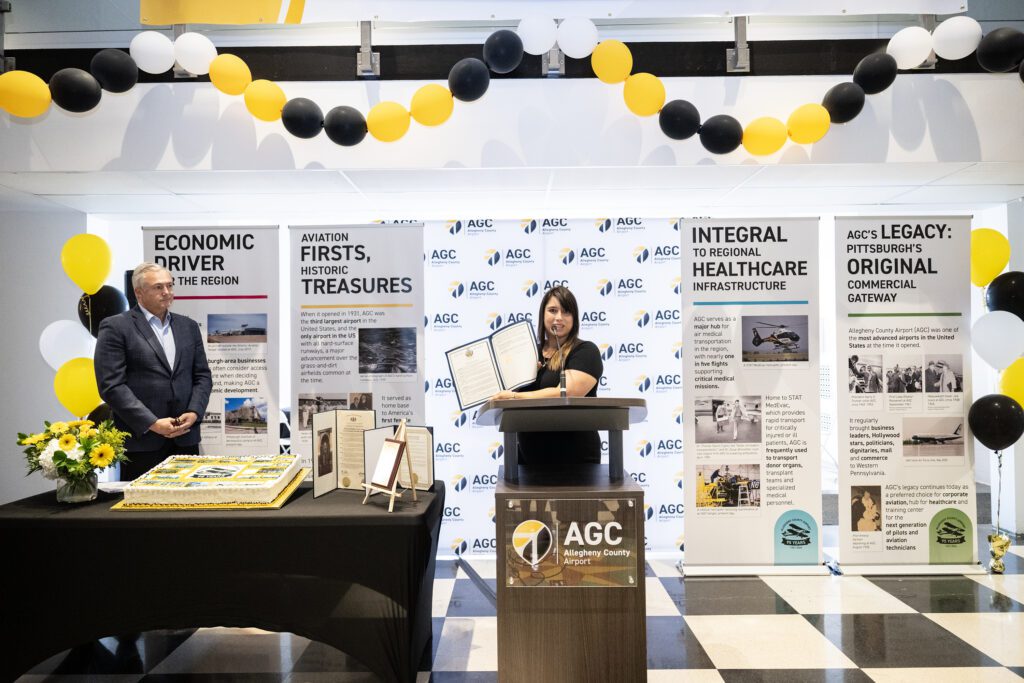
Allegheny County Executive Sara Innamorato presents a proclamation recognizing 95 years of operations at Allegheny County Airport on Sept. 18, 2026. (Photo by Beth Hollerich)
Located 10 miles southeast of Downtown Pittsburgh, AGC hosts approximately 60,000 flight operations per year.
“Allegheny County Airport’s history is important, and at the same time, its future is just as bright. Lives depend on this airport for medical-related flights, including organ transplants, and AGC also serves as Pittsburgh’s gateway for business and general aviation,” said Lance Bagnoff, Director, Allegheny County Airport. “We’ve also seen revenue grow as hangar capacity is nearly full and we continue to diversify revenue sources.”
Revenue at the airport jumped 8 percent from 2024 to 2025. This year through August, airport revenue is up 5.2 percent from the same point last year.
Medical Base
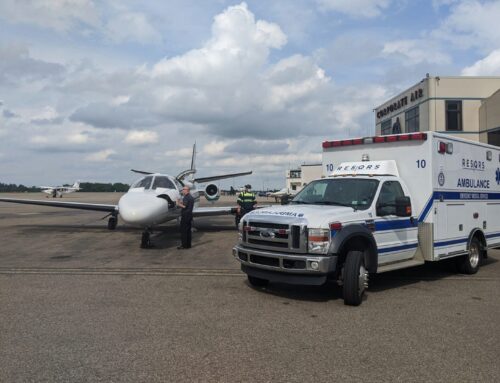
AGC is home to emergency medical helicopter services STAT MedEvac and Air Methods, which operates a regional maintenance base there, as well. Quest Diagnostics, which tests medical samples nationwide also regularly utilizes the airport, and RESQRS — the Regional Emergency Support Quick Response Service, has been based there since 2021. RESQPGH handles medical flights for patients, as well as for organ donations.
“This is an incredibly important facility for medical missions and one that we take very seriously,” said Allegheny County Airport Authority CEO Christina Cassotis.
Bagnoff said that nearly 20 percent of all flights arriving or departing from AGC are related to medical operations.
“Through these services, lifesaving medical operations are really the best example of how critical general aviation airports are,” Bagnoff said. “When our team is working in the middle of winter in a snowstorm to keep the runways open, it’s because we know there may be flights coming in that are part of organ recovery operations.”
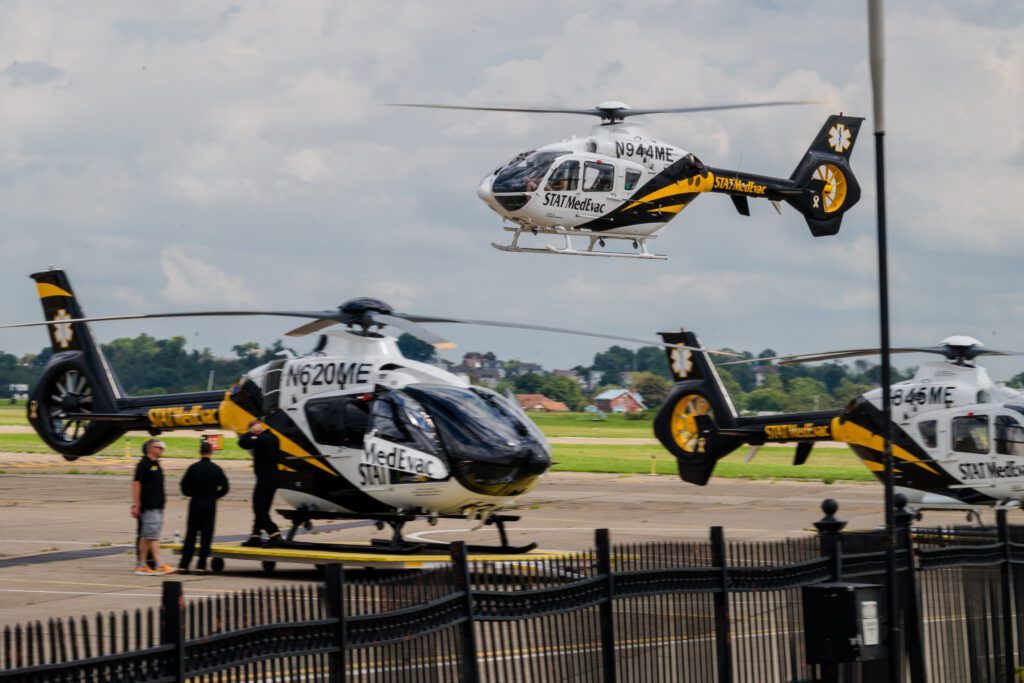
STAT MedEvac helicopters are prepped for flights at Allegheny County Airport. AGC is home to emergency medical helicopter services STAT MedEvac and Air Methods. (Photo by Beth Hollerich)
School at Airport for 80 Years
Beyond medical missions, AGC hosts two pilot schools – ATP Flight School and Cloud 9 Aviation – in addition to a nationally-recognized aviation maintenance school, Pittsburgh Institute of Aeronautics (PIA).
“There will always be air travel and there will always be a need for people who can fix and maintain aircraft. Young people are figuring that out,” said Steven Sabold, Executive Vice President at PIA.
The school, which has 300 students, has been housed at the airport since the 1940s. Its graduates are trained in avionics and airplane maintenance, jobs with pay that start at $60,000 to $80,000 and rise fast.
“For so many years, there has been a perception that you need to go to a four-year school. There are plenty of good paying skilled jobs that don’t require that,” Sabold said.
The airport, which opened in 1931, was built at the height of the Art Deco era when its paved runway was considered cutting edge.
Sabold says the airport is ideal for the institute. “It’s a great location. We’ve had a good run here. We strive to make sure our learning experiences are at the airport,” he said.
Schools like PIA provide a talent pipeline for aviation maintenance technicians. In July, American Airlines and PIA announced a partnership agreement where American will provide students exposure to maintenance careers through engagement opportunities with American’s maintenance professionals, including hands-on tours of the airline’s maintenance facilities.
“AGC is just one of the many assets that have been in the Mon Valley for a long time,” said Senator Nick Pisciottano, Pennsylvania State Senator for the 45th District. “The county and the Airport Authority do a great job of investing in those places and making sure that they continue to be generators for economic development and workforce development in our region.”
Additionally, top-performing students will receive guaranteed interviews for available positions with American upon graduation and receipt of their FAA Airframe and Powerplant certification, making it easier for students to launch careers maintaining one of the world’s largest aircraft fleets.
Officials said the agreement is a natural fit for the and American, which operates a large maintenance base at Pittsburgh International Airport with more than 700 employees.
It’s that popularity and the airport’s heavy use that aviation experts say all but guarantees a good future.
“It’s an important airport, highly critical and always has been, especially during World War II,” said Brian Butko, an author and historian at Pittsburgh’s Heinz History Center.
Butko, who grew up nearby, studied avionics at the airport’s aviation institute before earning a graduate degree in history. He’s co-author of BETTIS: Where Pittsburgh Aviation Took Off, about the early days of flying and barnstorming in Pennsylvania.
The airport was built on farmland. “It was seen as a boondoggle by many at the time. That opinion did not last,” Butko said.

Business Center
By 1952, when Greater Pittsburgh International Airport opened, the airport’s main business became private aviation. Before and after, the airport has seen a parade of notables pass through it, most presidents going back to Harry Truman and everyone from Eleanor Roosevelt to Elvis Presley.
The airport was designed by Stanley Roush, whose other projects – Pittsburgh’s County Office Building and the Clemente, Carson and Warhol bridges, known as the three sister bridges – are all Pittsburgh landmarks.
“This building is really a living history of aviation, not just in Allegheny County, but the region and the country,” said Matt Smith, Chairman of the Allegheny County Airport Authority Board. “This Art Deco building was among the first and most advanced airports in the nation at the time. From Eleanor Roosevelt and Harry Truman to Lena Horne, Bob Hope and Danny Kaye, this airport served everyone from presidents and first ladies to dignitaries. And of course, the airport served millions of passengers in Western Pennsylvania as the region’s main airport until 1952.”
Although no longer carrying commercial passengers, AGC hosts two FBOs, or fixed-based operators that almost act as smaller, private terminals frequented by business travelers – Atlantic Aviation and Vantage Aviation.
“From corporate jets and charters to private planes and training aircraft, FBOs cater to the executive nature of non-airline flights and their clientele, providing many of the same services,” Bagnoff said.
An FBO operates close to an airport, providing amenities for passengers, plane maintenance for operators and runway access. With sizes ranging from luxurious private terminal facilities to separate commercial airport entrances, FBO facilities offer convenience, scheduling flexibility and privacy. FBOs and general aviation airports like AGC allow for a unique passenger experience and alleviate congestion from larger commercial airports.
An estimated 5,200 FBOs operate in the United States, at both commercial and independent airports. FBOs generate revenue for the airport through multiple avenues including fuel sales and demand for hangar space.
As AGC begins its next chapter, the airport will continue to have an important role in aviation education, medical transportation and business aviation.
“Our board has every intention of continuing our investment here as well as allowing for the investment in people’s careers going forward,” Cassotis said.