
RESQPGH’s Lifesaving Mission Gains Momentum with Support from Allegheny County Airport
Nearly 20 percent of all flights arriving or departing from AGC are related to medical services
By Ethan Woodfill
Published December 8, 2025
Read Time: 4 mins
Michael “Gally” Gallagher has spent more than 21 years in Emergency Medical Services (EMS). His career includes more than a decade as an EMT Crew Chief with Economy Ambulance Service, as well as a professional medic firefighter in Richmond, Virginia.
“I’m certain I’ve helped maybe thousands of people,” he said. “And it’s a shame that most [first responders] don’t know what happens to their patients after they treat them.”
In 2022, Gallagher took a position at RESQRS — the Regional Emergency Support Quick Response Service, which has been based at Allegheny County Airport (AGC) since 2021. RESQPGH handles medical flights for patients, as well as for organ donations. The organization has more than 1,000 calls this year, including transporting organs, surgical teams, specimens and biopsies.
“We have an incredibly good relationship with the Allegheny County Airport,” said Gallagher, who is now the director of RESQRS. “A lot of these flights and ground transports are last-minute. Sometimes we have only 20 minutes’ notice to get out there and rendezvous with the team that’s flying in.”
“Through these services, lifesaving medical operations are really the best example of how critical general aviation airports are,” said Lance Bagnoff, director at the Allegheny County Airport. General aviation airports are public-use airports that do not have scheduled commercial airline service and are vital for supporting various aviation-related businesses.
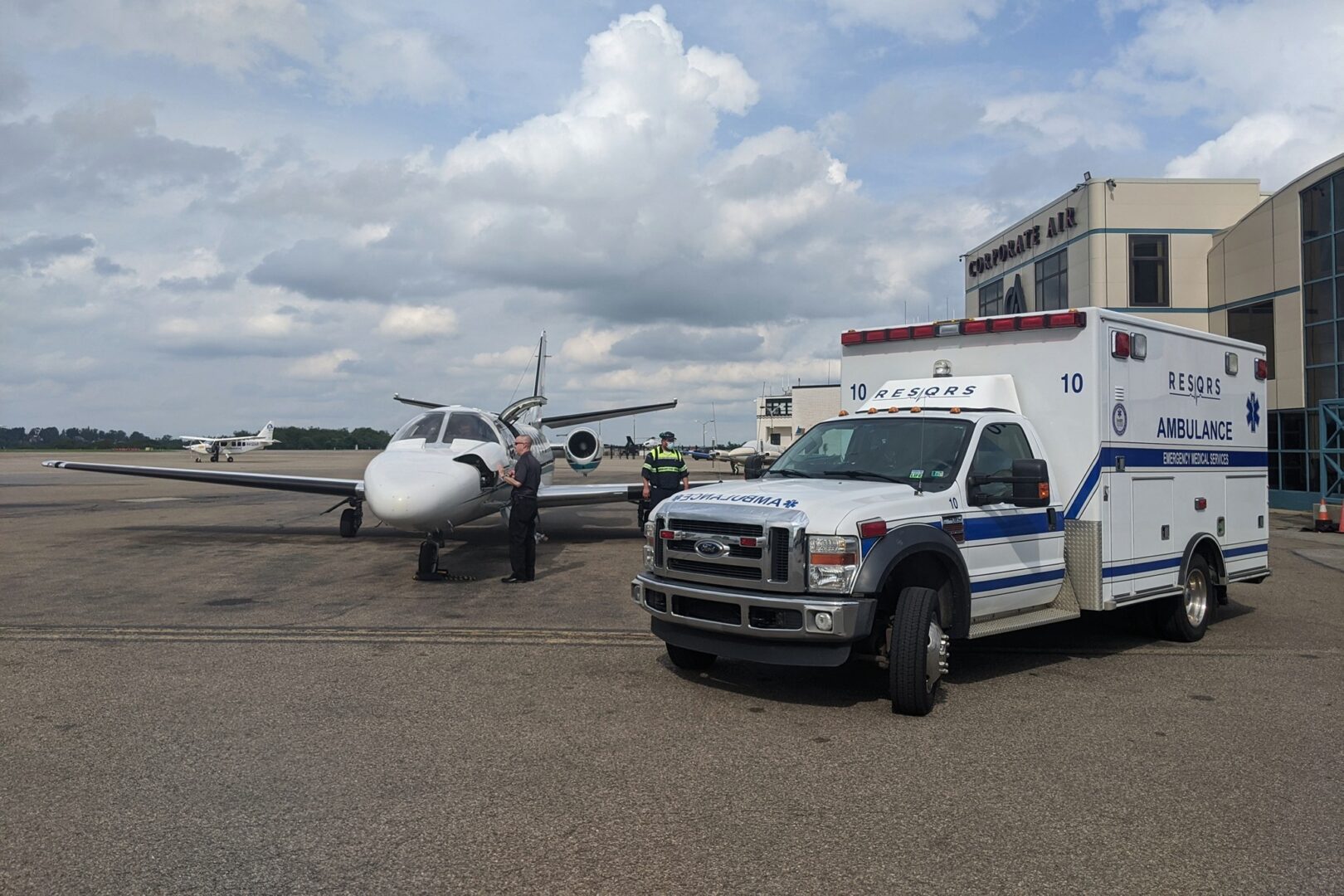
A RESQRS ambulance sits outside RESQPGH’s headquarters at its hangar at Allegheny County Airport. Nearly 20 percent of all flights arriving and departing from AGC are related to medical operations. (Courtesy of RESQRS)
Bagnoff said that nearly 20 percent of all flights arriving or departing from AGC are related to medical operations.
“When our team is working in the middle of winter in a snowstorm to keep the runways open, it’s because we know there may be flights coming in that are part of organ recovery operations,” Bagnoff said.
The AGC team as well as the team at Pittsburgh International Airport won The Balchen/Post Award this year for its snow removal efforts in maintaining safe and operational runways during winter conditions.
“What is incredibly rewarding with what we do is that we know we’re making a difference when we pick up a surgical team that’s carrying a heart from Nashville with lights and sirens to UPMC Children’s Hospital of Pittsburgh, where a child is going to get a new heart,” he says. “You absolutely know that you’re making a difference.”
RESQRS began in 2015 as Event Medic Pittsburgh, providing medical standby services at athletic events.
“There was and still is a huge need for that because a lot of ambulance services can’t provide that,” Gallagher said. “It’s limited pay, and they’re tying up a 911 ambulance crew. That’s where we got our start.”
From there, RESQRS identified a need for ground transportation between aircraft and hospitals, as well as between hospitals and planes.
“We were kind of the first in Pittsburgh to provide that,” he added. “We really have only one other competitor, and they are a nationwide organization. We’re the mom-and-pop coffee shop compared to Starbucks.”
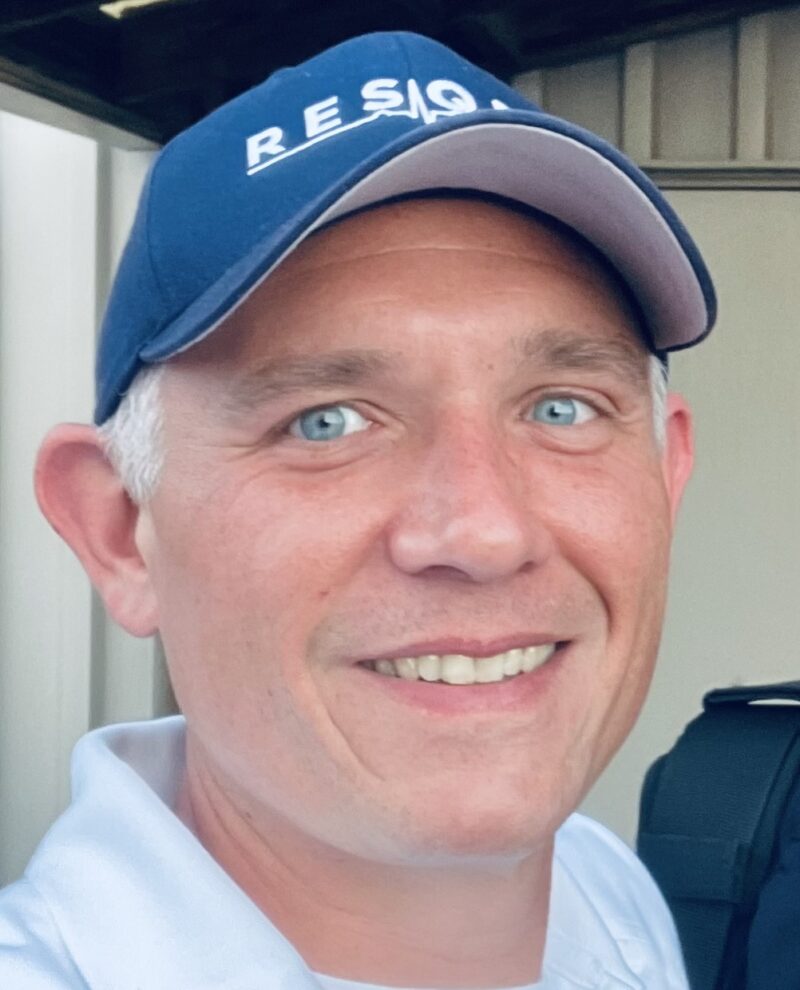
Michael “Gally” Gallagher is the director of RESQRS, which provides non-emergency ambulance discharges, flight team transports, special operations ambulance standbys, and 911 emergency medical services. It is based out of Allegheny County Airport. (Courtesy of RESQRS)
The team operates around the clock with staff at a dedicated hangar at Allegheny County Airport. Their responsibilities include dispatching and coordinating ground transport. Gallagher manages a complex and dynamic algorithm for alerting operating rooms, assembling teams and scheduling flights. He said that the county airport serves as an ideal strategic location, facilitating seamless logistics.
“We have independent contractors who help us perform the courier work,” he said. “These folks escort or drive the teams to where they need to go. I have an outstanding team.”
The arrangement is also beneficial for the organ procurement organization, the Center for Organ Recovery and Education (“CORE”), which operates across the region from Syracuse, New York, to Princeton, New Jersey, and Charleston, West Virginia.
“We know that the average person who’s waiting for a living kidney donor is waiting six months,” Gallagher said. “There are lots of hurdles to overcome to find a match and a reputable donor. We know the amount of joy it brings that we had a piece of that puzzle to get that organ to them.”