RIDC Envisions How Neighborhood 91 Can Help Drive Pittsburgh’s Economy
Nonprofit partners with ACAA to bolster advanced manufacturing
By Roman Hladio
Published January 12, 2026
Read Time: 7 mins
When the Regional Industrial Development Corporation (RIDC) of Southwestern Pennsylvania took over development management of Neighborhood 91 — an advanced manufacturing campus at the Pittsburgh International Airport — in March 2025, it was the latest chapter in the organization’s 70-year history of partnering on economic development in the region.
“RIDC’s role as master developer positions Neighborhood 91 for sustainable, mission-driven growth,” wrote Jen Coyne, director of programs for The Barnes Global Advisors, which serves as strategic consultants for the site. “Their track record of developing industrial manufacturing campuses that support innovation, workforce, and regional competitiveness makes them a natural steward of the neighborhood’s next phase.”
Neighborhood 91’s inclusion in RIDC’s portfolio signifies a leap toward the goal of creating a manufacturing “industrial cluster” in the region, according to RIDC Senior Vice President Tim White. RIDC’s investment in similar properties — like the Westmoreland Innovation Center, New Kensington Advanced Manufacturing Park and Hazelwood Green’s Mill 19 — reflect its belief that manufacturers want to set down roots in Pittsburgh and that the local economy will reap the benefits.
What sets Neighborhood 91 (also known as N91) apart, though, is its proximity to the airport.
“Additive manufacturing, in the state of the industry now, is building highly specialized parts,” White said. “If a part breaks, its creators are literally next-door neighbors to the airport. It can be on a plane and shipped almost as soon as the call comes for it.”
“The airport itself is a valuable piece of our region’s economic infrastructure, and its success is important to the region’s business attraction efforts. N91 is an exciting project that has the potential of attracting companies in strategic industries and having a catalytic effect on the region’s economy. It’s gratifying to be able to work in partnership with a forward-thinking, action-oriented partner like the Allegheny County Airport Authority (ACAA), led by CEO Christina Cassotis,” RIDC President Donald F. Smith Jr. said in a March statement.
While RIDC’s presence at the airport-adjacent hub is new, the economic development nonprofit’s strategy at the site is far from novel. Over the past 70 years, RIDC has been creating space for industrial opportunities to grow in the region.
It saw the rise — and fall — of the steel industry, and made bets on “eds and meds,” life sciences, robotics and autonomy sectors that flourish in Pittsburgh today.
“I can’t say we know exactly where all these industries are going, but we know to try to place some bets strategically with our public partners, our private partners, to make Pittsburgh a little more competitive, and that’s what we’re trying to do [at Neighborhood 91],” White said.
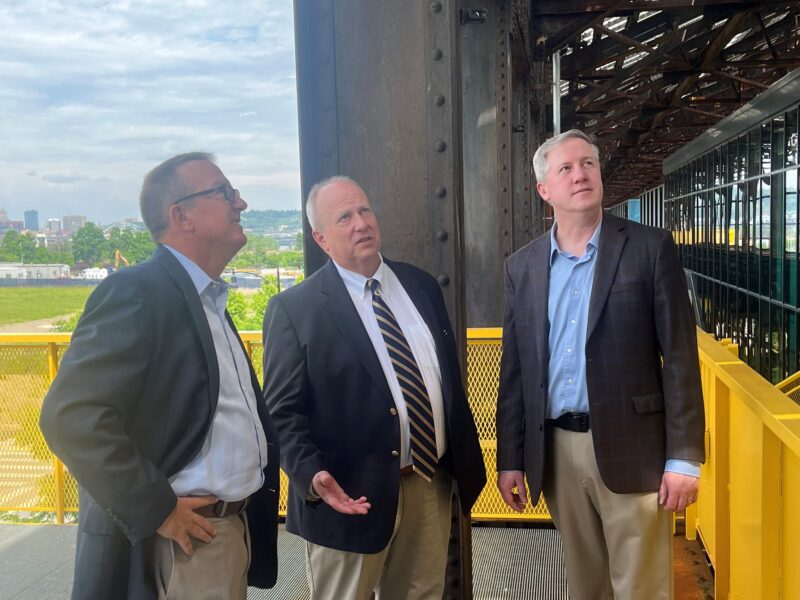
From left, RIDC Senior Vice President Mike Goldstrom, RIDC President Don Smith and RIDC Senior Vice President Tim White at the Mill 19 site in Hazelwood Green near downtown Pittsburgh. (Courtesy of RIDC)
Diversifying the economy
RIDC was created in 1955 by some of Pittsburgh’s leading industrialists; its original board included representatives from Westinghouse Electric Corporation, Carnegie Tech’s School of Industrial Administration, U.S. Steel, Equitable Gas, Duquesne Light, Mellon National Bank and Trust Company and the Baltimore and Ohio Railroad.
Their task, put simply, was to evaluate the regional economy.
“Coming out of World War II, we’re still heavy industrial plants all along the rivers, we’re cleaning up the pollution with the transition from coal to natural gas, flood control was a big effort,” White says. “I think those industry leaders at the time were thinking, ‘Well, we need to diversify our economy. We’re so concentrated on heavy industry, it’s unclear how competitive we can be for the decades to come.’”
With annual dues from some of the city’s biggest companies, RIDC began acquiring real estate to develop light industrial parks in the 1960s. The first was RIDC Industrial Park on Route 28 in O’Hara Township. Two more were quick to follow: Thorn Hill Industrial Park in Marshall and Cranberry Townships and Park West Industrial Park in Findlay Township.
“RIDC did the initial roads and infrastructure, site grading,” White says. “We built a few buildings to get it started and then sold off property to private developers to stimulate the market and get more activity.
“We now live off those proceeds. We don’t get any operating funding from the government. We live off the rents and land sales of, essentially, that initial core investment recycled from project to project.”
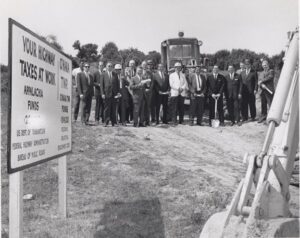
In the 1960s, RIDC began acquiring real estate to develop light industrial parks, starting with RIDC Industrial Park in O’Hara Township. (Courtesy of RIDC)
The rise of eds and meds
That asset base would prove instrumental to both RIDC and the local economy as the steel mills began closing within the ensuing two decades. White said that by the 1980s, RIDC was coordinating with county, state and city partners to make real estate investments in education and medical institutions.
One of the most crucial, he said, was the Software Engineering Institute in Oakland, which bolstered Carnegie Mellon’s computer science department. RIDC also invested in the Magee-Womens Research Institute and University of Pittsburgh and Carnegie Mellon structures.
“All that was about building that university research base so it could pivot more toward creating commercial outputs,” White said.
“Eventually, that led to … the site acquisition for the National Robotics Engineering Consortium in Lawrenceville, and then we did a couple buildings close by — first one being the Chocolate Factory, which housed start-ups in the robotics field.”
The potential of brownfield sites
At the same time, the groundwork was being laid for what would become RIDC’s bread-and-butter: brownfield site conversions.
Throughout the 1980s and 1990s, RIDC spent tens of millions of dollars removing asbestos, oils and other hazardous materials from former industrial sites in McKeesport and Duquesne, but existing environmental regulations didn’t define clear remediation goals or even allow for development on such properties.
At the time, there was a lack of scientific research showing that brownfield sites could be cleaned up for reuse, White said. That lack of evidence made it hard to set standards for remediation, which in turn made it impossible for developers to be relieved of liability relating to the site, which then made it difficult to attract financial support.
Come 1995, research began cropping up and dominos began falling favorably into place. That year, Governor Tom Ridge signed the Pennsylvania Land Recycling and Environmental Remediation Standards Act, or “Act 2,” into law, which encouraged site cleanup through private — not taxpayer — dollars, created clear remediation goals and established a pathway to reduce developer liability.
“We did the first brownfield in Pennsylvania — one of the first in the country — which was the Pittsburgh Technology Center,” White said.
A certified deluge of others would follow: Keystone Commons, McKeesport National Tube Site, U.S. Steel Duquesne, Oakmont’s Edgewater Steel, Lawrenceville’s Heppenstall Steel and, most recently, Hazelwood Green.
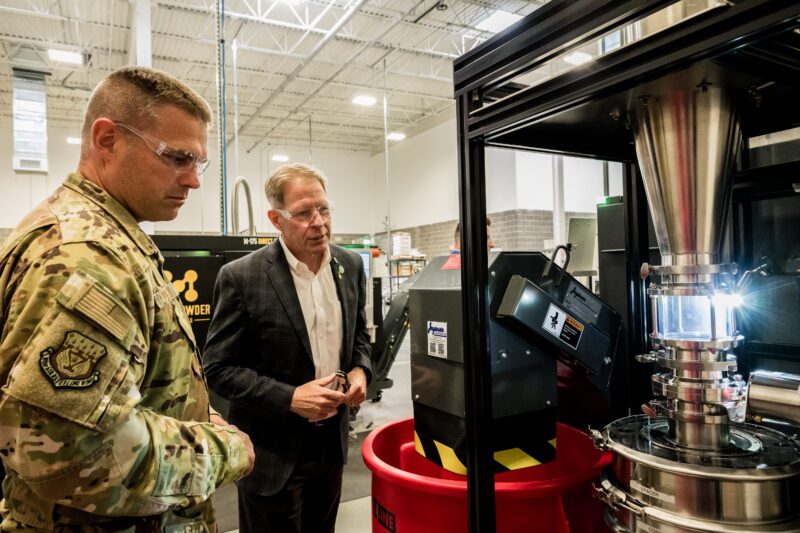
Announced in 2019, Neighborhood 91’s initial 13-acre phase includes a multi-tenant facility and a separate powder storage unit. Tenants include Cumberland Additive, HAMR Industries and Metal Powder Works. (Photo by Beth Hollerich)
Investing in the future
All the while, RIDC has continued leveraging its projects to generate assets to invest into subsequent projects.
“We sold [The Pittsburgh Technology Center] in 2013,” White said. “We took all the cash from that building and plopped it into Mill 19. If we were a typical real estate developer for profit, that would have been distributed among whoever the individual or corporate investors were, but if we make money on something, we recycle it back into the next project.
“Unfortunately, not every project has had [a positive exit]. The tens of millions of dollars in some of these old steel mill sites — it’ll be way past my lifetime before we get to break even from a historical cumulative investment standpoint.”
RIDC’s latest bet in additive manufacturing is a confluence of its work over the last 70 years; many of the pieces being manufactured are used in the robotics and autonomy industry that grew out of Pittsburgh’s education institutions.
White calls this interlocking web of assets a “cluster.”
“When you have a strong cluster, it reinforces itself because it has a gravitational pull that brings in suppliers, customers and talent to say, ‘If I want to be in this industry, I have to be in this region,’” he said. “Once we get enough of a concentration, other people will show up to the party, and then it becomes the destination.”
Neighborhood 91’s initial 13-acre phase, part of the master plan announced in 2019, includes a multi-tenant facility and a separate powder storage unit. Tenants include Cumberland Additive, HAMR Industries and Metal Powder Works.
Now, expansion is on the docket for the 195-acre site. White said that this past fall, RIDC received Findlay Township Planning Commission approval to build a new 100,000-square-foot manufacturing building across from the existing structures, with construction set to start in 2026.
“Since our founding, our mission has been responding to whatever the region’s needs are and trying to keep a pulse on the region, but also what the rest of the world is doing,” White said. “We take a lot of swings. They don’t all turn into all homeruns, but we’re trying to do things where the private return might not be evident yet, but the public return for us as a region competing in some of these realms is great.”
In the short term, he expects that Neighborhood 91’s addition to the manufacturing mix will make the Pittsburgh manufacturing cluster reach further than ever before.
“You’re not building nails, you’re building a part that’s going on a plane, a spaceship, a naval ship,” White said. “It needs a high fidelity, but it has to be specifically constructed.
“Our proximity to the Midwest and the East Coast is big, and the airport will be a great gateway to those markets in terms of shipping these things out quickly.”
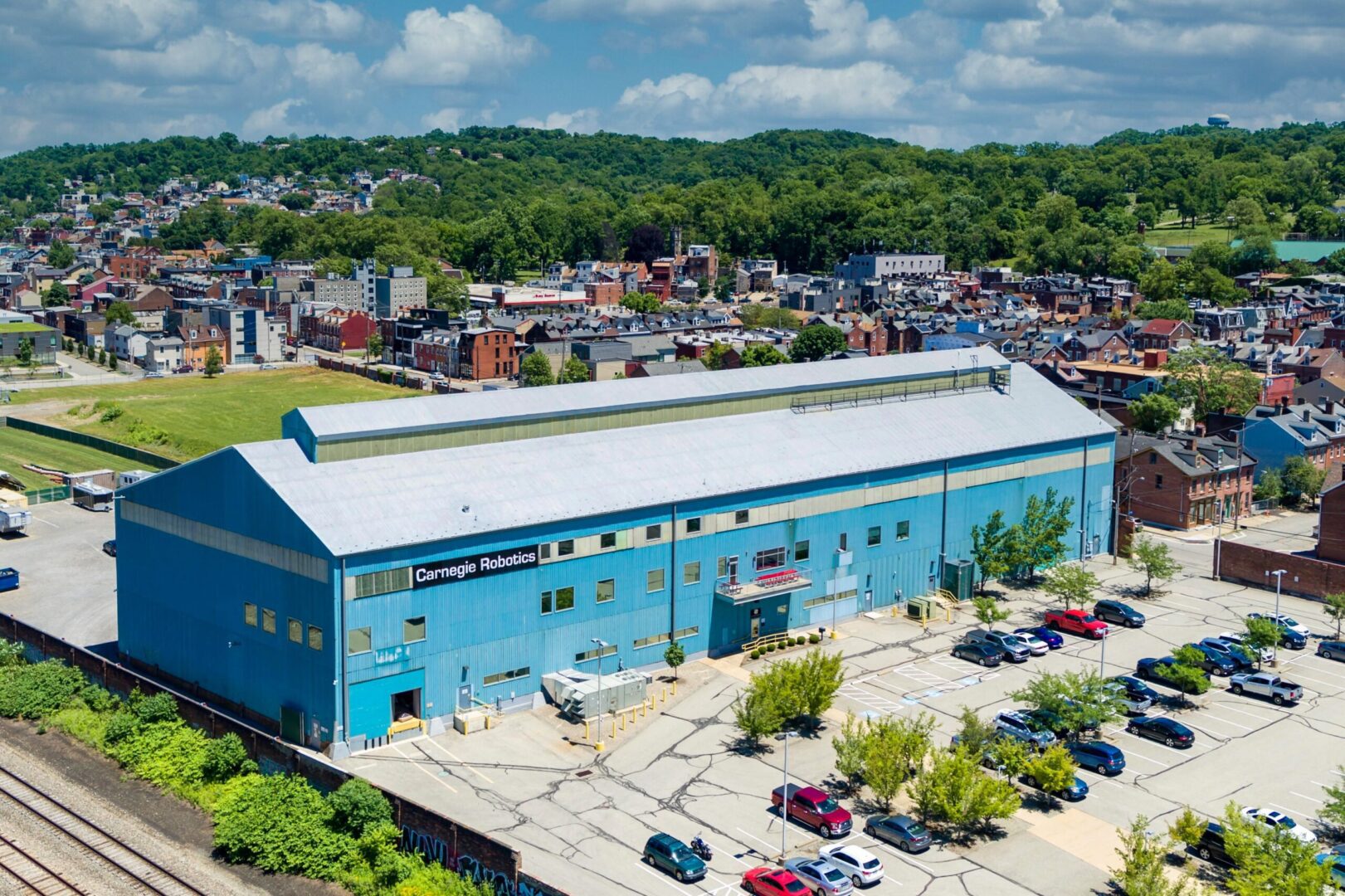
Top photo: Carnegie Robotics is based at the Lawrenceville Technology Center, a former Heppenstall Steel industrial site that RIDC acquired in 2002. (Courtesy of RIDC).