Pittsburgh Tech Powers Aviation Industry Innovation
Homegrown Skild AI partners with PIT to test four-legged robots as part of latest xBridge innovation in the terminal
By Daniel Lagiovane
Published September 29, 2026
Read Time: 6 mins
Already known globally as the robotics capital of the world, the Pittsburgh region is continuing to grow its tech prowess as part of its industry-leading new airport.
Pittsburgh International Airport’s xBridge innovation program, which has worked with dozens of tech firms from start-ups to national companies, is once again serving as a real-world proving ground for emerging technology.
Airport leaders announced two partnerships this week with companies testing cutting-edge products designed to enhance aviation industry efficiency, operations and customer service.
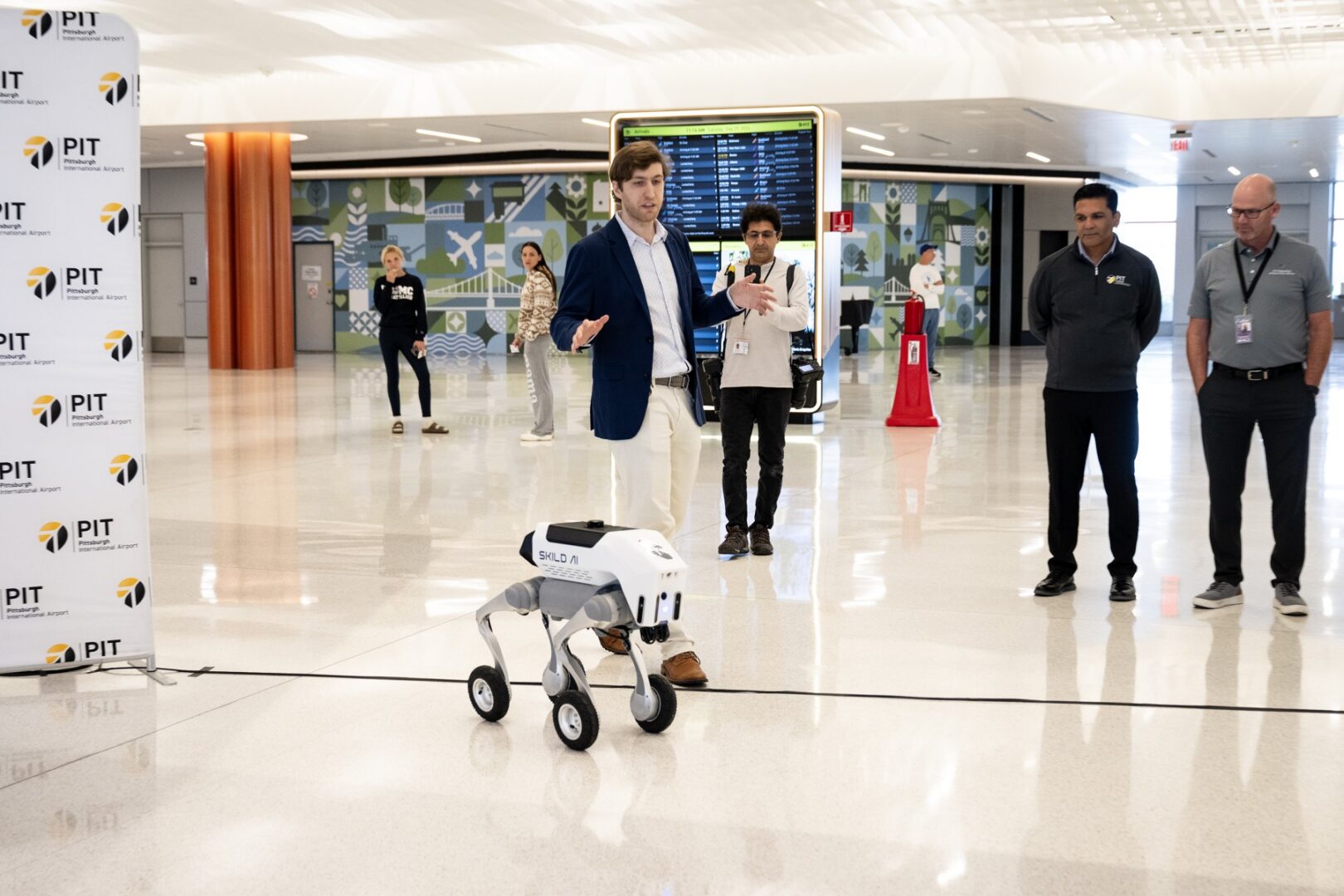
Passengers may soon notice four-legged robots, or quadrupeds, strolling through parts of the Airside Terminal supporting terminal operations from monitoring indoor air quality to detecting spills and full trash bins among other uses.
The robots, powered by Skild AI’s adaptive autonomy software, are being evaluated for their ability to navigate complex airport environments and assist airport operations. Equipped with advanced sensors, cameras and AI-driven perception, the robot can roam autonomously, detect anomalies, and provide real-time data to operations staff.
The announcements come as Pittsburgh is hosting the Intelligent Robots & Systems (IROS) Conference 2026, an international event with more than 70 countries represented.
“Pittsburgh is a global leader in robotics and AI. Through xBridge, we’re creating a place where that innovation can move from the lab into the airport environment and ultimately help shape the future of the industry,” said Deepak Nayyar, Executive Vice President and Chief Technology Officer at PIT. “We’re looking at how the latest technology can work alongside our staff and airline partners to enhance efficiency, improve operations and provide an additional level of customer service.”
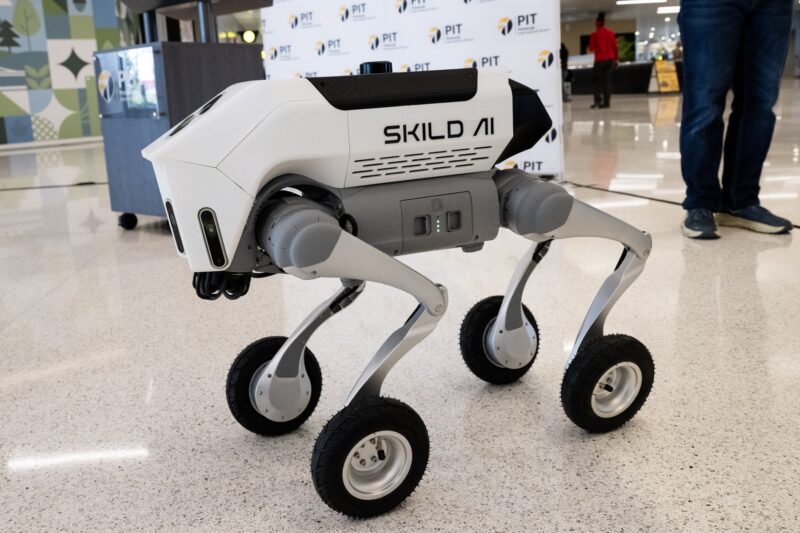
Skild AI’s quadruped robot operates as part of a demonstration at PIT on Sept. 29, 2026. The robot’s proof-of-concept testing is part of the airport’s xBridge Innovation Center. (Photo by Beth Hollerich)
Up to four autonomous robots and two charging stations will be deployed across the Airside Terminal. Each will have a defined area and keep-out zones. Skild AI will conduct the installation, mapping, supervision, and monitoring. They will also provide on-site training to PIT staff.
“As a Pittsburgh company, we’re proud to partner with xBridge to make Pittsburgh International a pioneer in airport robotics,” said Sara Ahmadi, head of product at Skild AI. “We share the belief that robots will transform how public infrastructure operates, and we’re grateful for the confidence they’ve put in Skild and the energy they bring to making that happen.”
The project will progress through multiple phases, allowing PIT and Skild AI to evaluate the technology across a range of airport functions.
Skild AI was founded in 2023 in Pittsburgh by Deepak Pathak and Abhinav Gupta, both faculty members of Carnegie Mellon University’s Robotics Institute and School of Computer Science. Pathak — the Raj Reddy Associate Professor at CMU — serves as chief executive; Gupta serves as president.
The company’s trajectory has been one of the fastest in the current AI cycle. Backed by SoftBank Group, NVIDIA Ventures, Macquarie Capital (entities administered by Macquarie Capital), Jeff Bezos, Sequoia Capital, Lightspeed, Coatue, Felicis, and others, the company is valued at over $14 billion.
Environmental Monitoring
The initial use case will focus on mobile indoor air-quality monitoring. Equipped with environmental sensors, a robot will autonomously collect location-specific data, monitor established thresholds and alert airport personnel when readings fall outside defined parameters. By automating routine data collection, the technology could help teams identify potential issues quickly.
Supporting Terminal Operations
The second phase will explore applications designed to complement the work of custodial and terminal operations teams. Potential use cases include identifying full or nearly full trash bins so employees can prioritize service, detecting potential spills to accelerate response and reduce safety hazards, and monitoring passenger congestion to give operations teams additional visibility into areas experiencing increased crowding.
Advanced Applications
The third phase will explore more advanced applications, including a potential partnership with BioFlyte, a former xBridge participant, to pair Skild AI’s quadruped platform with BioFlyte’s airborne biological threat detection technology. The combination could provide mobile biological monitoring beyond fixed sensor locations and give airport personnel another tool for identifying potential threats.
The project will also evaluate the potential for autonomous delivery, including food and beverages, to select locations within PIT’s airside terminal. If successful, autonomous delivery could also support employees by handling routine point-to-point transportation of items, allowing staff to remain focused on passengers and core operational responsibilities.
“Pittsburgh is known globally for its growing tech economy, and our new industry-leading terminal continues to reflect that innovation right at the airport,” said Allegheny County Executive Sara Innamorato. “The airport is an economic driver for the region and xBridge is another example of that success.”
For PIT’s airline partners, the project offers an opportunity to explore how autonomous technology could work alongside the people who keep an airport operating efficiently every day.
Arrow Analytics at Gate A7
As part of a separate xBridge project, Arrow Analytics, in partnership with Southwest Airlines, is testing its EZ-Board technology in an active terminal environment to explore how the system can improve the boarding process and give airline teams better real-time information on how full overhead bin space is on the flight before a passenger boards.
Airlines closely monitor boarding times because even a few minutes can affect aircraft schedules across an entire network. When overhead space becomes constrained, airlines may ask passengers to gate-check carry-on bags. PIT, Southwest Airlines and Arrow Analytics are exploring whether new technology can provide an even more precise, real-time view of carry-on baggage during boarding.
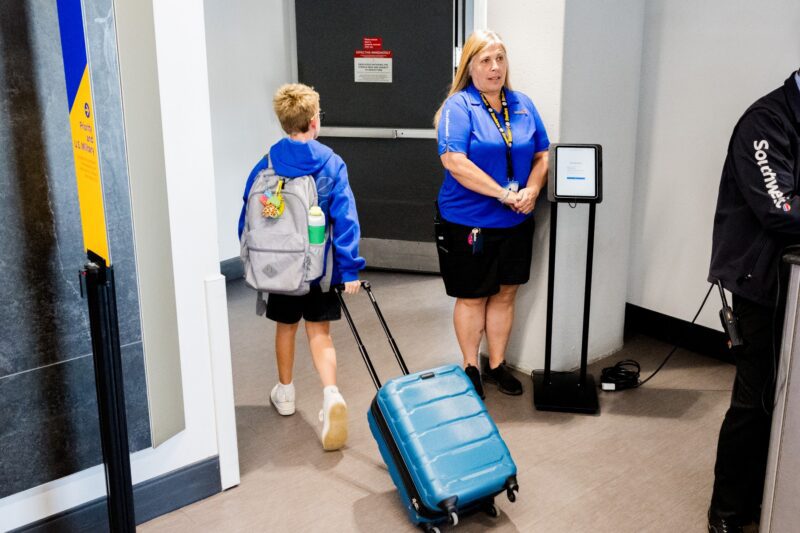
In partnership with the airport’s xBridge Innovation Center and Southwest Airlines, Arrow Analytics is testing its EZ-Board technology at gate A7 at PIT. The program calculates how much overhead bin space is available on the plane in real time based on the number and size of carry-on bags and relays the information to gate agents. (Photo by Beth Hollerich)
Arrow Analytics has developed EZ-Board, an autonomous system that uses off-the-shelf depth cameras and real-time analytics to identify how carry-on bags move through the boarding process. The technology, installed at Gate A7 at PIT, gives airline gate agents and operations teams a real-time picture of baggage volume, while also helping predict how much overhead bin capacity will be needed.
“We are excited to work with the innovative team at PIT as we continue to develop our EZ-Board product and computer vision offerings for airports and airlines,” said Valerie McNeill, Chief Operating Officer of Arrow Analytics.
Providing airline employees with better information about actual baggage volume and projected bin usage could increase boarding speed, reduce uncertainty and support more consistent, data-driven decisions.
xBridge at Pittsburgh International Airport
Small tech companies often face challenges testing their concepts.
“The airport is a huge resource in the region that can be utilized to support these early-stage tech companies,” said Nayyar.
xBridge, the tech innovation center located at PIT, plays a crucial role in the development and deployment of innovations within the aviation industry. It collaborates with startups, universities, and industries, providing a testing ground for new technologies and facilitating partnerships between tech companies and the airport.
“Additionally, it gives people in the industry, the people who run the airport, an opportunity to see, touch, feel and understand how technology can assist their work,” Nayyar said.
From remote-operated cars with Mapless AI to Blueberry, an autonomous wheelchair provider, to Journey Robotics, an automated baggage handling system, xBridge serves as a testing ground for companies.
xBridge partners with companies to identify proof-of-concept projects at the airport that enable them to develop, test, or demonstrate their technology, product, or service.
Airport business units have the opportunity to see these companies in action and sometimes seek to partner with them through xBridge to deploy their tech in a pilot capacity for a specific use case.
“Pennsylvania has an incredible opportunity to lead in artificial intelligence, robotics and emerging technologies. The xBridge program demonstrates how bringing innovators, industry partners and our airports together can turn promising ideas into real-world solutions,” said state Rep. Valerie Gaydos, whose district includes the airport. “But we must always remember that technology should work for us, not the other way around and xBridge is showing exactly how AI and robotics can solve real-world problems, improve efficiency and help Pennsylvania lead in innovation while benefiting our businesses, workforce and communities.”
Pittsburgh offers a space for tech incubation
Pittsburgh is also home to world-class technology accelerator programs at Carnegie Mellon University and the University of Pittsburgh. CMU’s Swartz Center for Entrepreneurship features Project Olympus, an incubator that supports CMU entrepreneurs from concept development to business creation. To date, Project Olympus has facilitated the formation of 324 companies from various startup projects.
Journey Robotics was recently awarded a $100,000 investment and mentorship from CMU’s new Tartan Entrepreneurs fund and was part of the 2024 cohort of the Robotics Factory accelerator program.
Meanwhile, Pitt’s Innovation Institute serves as a hub for innovation and entrepreneurship, providing support for technology commercialization and startup funding. The program has successfully launched over 100 startup companies.
Additionally, Pittsburgh’s cost of living offers a competitive advantage compared to other tech-centric regions, such as Silicon Valley.
Of the 50 largest U.S. metro markets, Pittsburgh ranked first in affordability those earning a median income, according to the latest report from Realtor.com.