New UPMC Terrace at PIT Connects Visitors to Western Pa. Landscape
Public can experience region’s woodlands, river valleys, meadows at pre-security terrace
By Daniel Lagiovane
Published July 29, 2026
Read Time: 7 mins
Travelers and visitors alike can now experience the woodlands, valleys and meadows of the region at a newly opened terrace at Pittsburgh International Airport (PIT).
“People really feel better when they have access to nature, and we’ve got a lot of nature in Pittsburgh,” said Christina Cassotis, CEO of the Allegheny County Airport Authority. “We really think this is going to make a difference with how people feel when they’re here at the airport.”
The first of four terraces, the pre-security UPMC Terrace, opened to the public on Wednesday as part of the new terminal.
The terraces represent PIT’s broader commitment to biophilic design, an approach that incorporates natural elements into the built environment to promote comfort and well-being. The design principle is based on the idea that humans have an innate affinity for nature.
This method is seen throughout the new terminal, where travelers encounter abundant natural light, nature-inspired architecture and materials that reflect the region’s landscape. Terraces extend that philosophy outdoors, creating spaces where passengers and visitors can take a break, enjoy sunshine and reconnect with nature before or after a flight.
READ MORE: Pittsburgh International Airport Opens Unique Terrace Available to Public
Visitors can access the UPMC Terrace on the Arrivals Level at the Welcome Point near the VisitPITTSBURGH desk or between baggage carousels 5-8. The UPMC Terrace is the first of four to open, which collectively received support from the Richard King Mellon Foundation, Henry L. Hillman Foundation, federal grants and corporate sponsorship.
Unmistakably Pittsburgh
The terraces are also part of PIT’s dedication to making the airport unmistakably Pittsburgh — celebrating the region’s culture, identity, community and environment through design.
Landscape architect OJB Studios’ designs for the four terraces were inspired by the landscapes of southwestern Pennsylvania and the Appalachian region.
The UPMC Terrace alone boasts more than 40 artfully combined species of trees, shrubs and perennials, with approximately 60 percent of the planting palette made up of native species. These native and climate-adapted plants support pollinators and ecological resilience, as well as help create an authentic sense of place that connects visitors to the natural beauty of western Pennsylvania.
A mix of flowering perennials, grasses, shrubs and evergreen species provides changing color, texture and visual interest across all four seasons. The thoughtful design creates a dynamic, year-round experience that reflects the beauty of Pennsylvania’s changing seasons, from early spring blooms and peak summer conditions to the beauty of fall colors and colder winter months.
READ MORE: Prestigious International Organization Selects PIT Among World’s Most Beautiful
“From the beginning, we wanted the terraces to feel inviting throughout the year, not just during the peak growing season,” said Samantha Partington, OJB Studios technical director. “While the terraces are designed as occupiable landscapes, they’re equally important as viewing gardens and visual landmarks that passengers experience from inside the terminal throughout their journey. Even for those who never step outside, the changing landscape becomes an integral part of the airport experience.”
Executive Director of the nearby Pittsburgh Botanic Garden Abigayle Tobia attended the Wednesday ribbon-cutting event for the UPMC Terrace.
“Gardens — and terraces like this — provide an opportunity for individuals to reflect in a season of change, at a time when they need calm and reprieve from busy life. And that’s the important part of having space and allocating that time and energy for folks to connect with nature, plants and pollinators, and even just a bit of sunshine.”
Tobia said people should look to plants responding to the changing seasons of western Pennsylvania, or even just after a rainstorm or during a dry spell, see how the native plants are interacting with the weather.
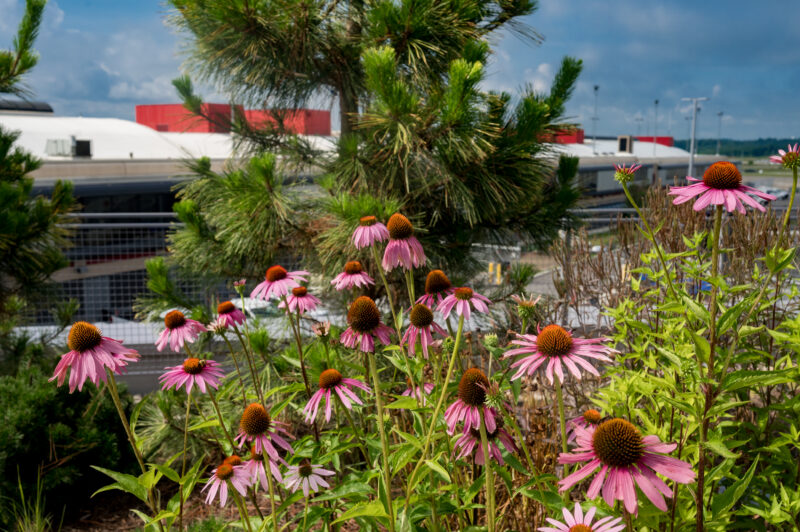
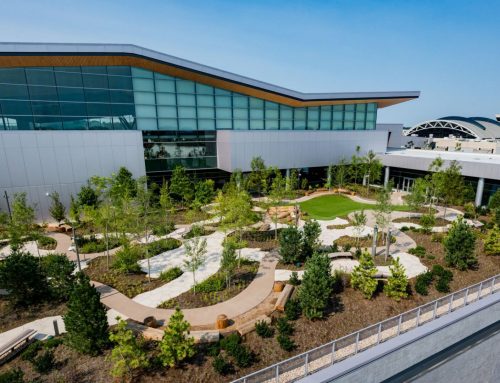
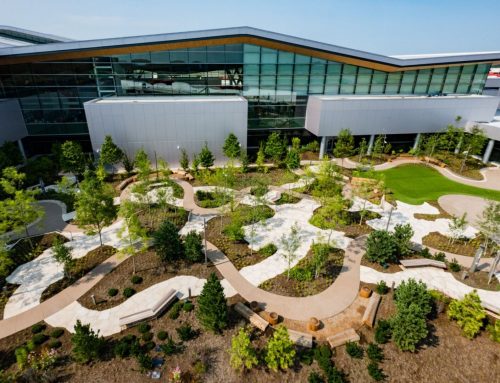
The UPMC Terrace features 41 plant species in four distinctive planting character zones: woodland, meadow/prairie, river valley and upland/plateau. (Photo by Beth Hollerich)
The terraces also presented a unique challenge. The OJB team was limited in what they could include in each space because the landscape had to comply with the airport’s strict wildlife management requirements.
Plant selections were carefully made to reduce the attraction of birds and other animals that could pose safety risks to aircraft. As a result, the team balanced aesthetic goals with airport safety requirements to create a vibrant landscape that is both attractive and functional.
All four terraces will be irrigated by a rainwater harvesting system that was part of the airport’s new terminal construction and reduces the need for potable water. The system captures rainwater from the terminal’s roof and stores it for reuse, rather than sending it directly to the stormwater management system.
The system is part of the airport’s broader sustainability strategy, which also includes native plantings, low-flow plumbing fixtures, stormwater management features and the airport’s on-site microgrid powered by natural gas and solar energy.
“It’s so incredible to see a space like this incorporated into an airport and taking sustainability to the next level,” said Brian Gongaware, project architect with Gensler, who collaborated with HDR and luis vidal+architects in designing the new terminal. “I think that this is really an amazing precedent for the aviation industry.”
More than just outdoor space
A second pre-security terrace, as well as the Green Spine, and two additional post-security terraces will also open in the future to provide additional outdoor seating areas designed for relaxation and informal meetings. They also will offer year-round panoramic views of the airfield and surrounding landscape.
“I think one thing that the modern-day airport, and PIT specifically, is understanding that airports want to be more human-centric,” Gongaware said. “I think PIT sets the benchmark for other airports to learn from.”
The terraces are designed as welcoming spaces for everyone, reflecting PIT’s commitment to universal access — offering intuitive circulation, open sightlines, comfortable gathering areas and inclusive environments that allow all travelers, as well as the public, to experience the benefits of nature and fresh air.
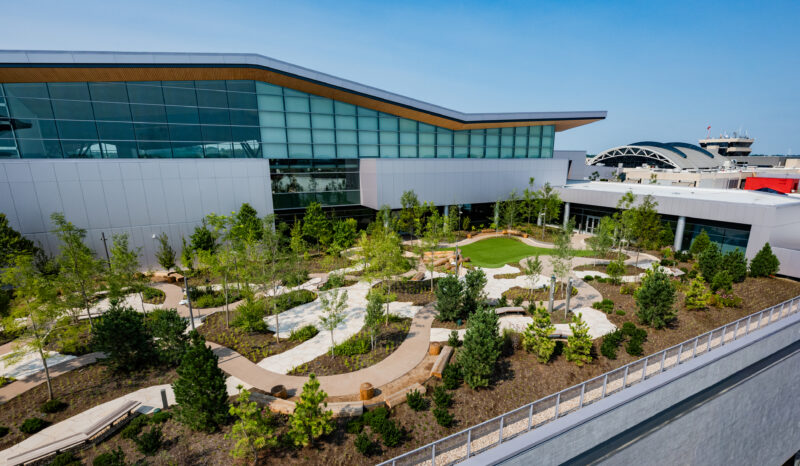
An aerial view of the UPMC Terrace located on the Arrivals level pre-security at PIT. The terrace is designed as a welcoming space for everyone, offering intuitive circulation, open sightlines, comfortable gathering areas and inclusive environments that allow all travelers and visitors to experience the benefits of nature and fresh air. (Photo by Beth Hollerich)
“One thing we learned through the design process is that Pittsburgh has a particularly strong culture of people meeting and greeting friends and family at the airport,” said Partington. “In addition to enhancing the passenger experience, the terraces provide meaningful outdoor spaces for employees, visitors and those welcoming arriving travelers, people whose connection to the airport is extended beyond that of a typical traveler.”
In addition to the wellness and social benefits, Ken Greene, assistant professor of the practice at Embry–Riddle Aeronautical University, said outdoor spaces can also have a positive economic impact on the region.
“An important role of an airport is to be an economic driver to its region,” Greene said. “Airports are often the first and last touch points a traveler has. When amenities like outdoor spaces are available, it creates a positive experience and impression. The more passenger experience offerings an airport has, the more likely people are to come back for business or personal travel. They will also recommend traveling through these airports to others.”
The future of terraces at PIT
OJB is especially proud of the newly opened UPMC Terrace and its unique features.
There are spaces where children can run and play. Areas for groups to gather. And quieter corners where someone can simply sit and enjoy a peaceful moment before going through security or as they wait for arriving passengers.
The 36,000 square-foot terrace draws inspiration from the Western Allegheny Plateau. This broad ecoregion extends across parts of Western Pennsylvania, Eastern Ohio, Northern West Virginia, and Northeastern Kentucky. It is characterized by steep rolling hills, major rivers and valleys.
On this terrace, 41 species are planted in four distinctive planting character zones: woodland, meadow/prairie, river valley and upland/plateau.
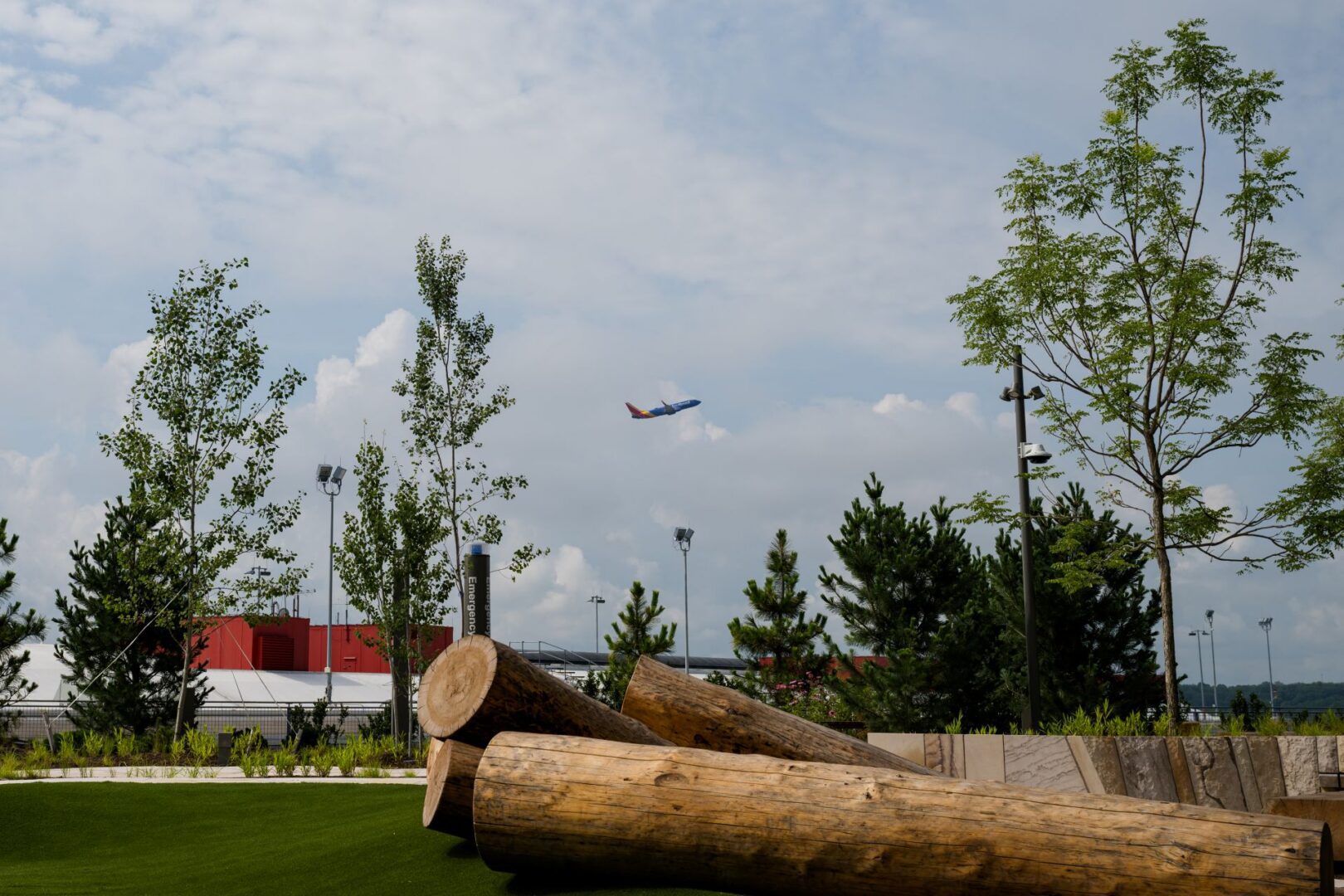
Regional character comes through in the details. The craftsmanship of the locally sourced sandstone walls, the felled timber elements and the gently curving walkways all work together to create a landscape that feels distinctly rooted in Pittsburgh and, more specifically, the river valleys of the Western Allegheny Plateau region.
“It doesn’t feel like a landscape that could exist anywhere; it feels like it belongs here,” Partington said. “We are also looking forward to seeing all those different experiences come to life and seeing the spaces activated.”
Connected across multiple levels, the UPMC Terrace feature layered planting, natural stone detailing and varied topography that reflects the steep ridges, narrow valleys and exposed rock formations characteristic of this ecoregion.
“The terraces aren’t simply outdoor spaces,” Partington said. “They are an extension of the terminal experience, helping travelers connect with nature, with the character of southwestern Pennsylvania and with each other. Whether someone spends a few minutes outdoors or simply looks out over the landscape from inside the terminal, we hope the experience leaves them feeling calmer, more refreshed, and with a stronger and more memorable sense of the place they’ve arrived in.”