Chicago Airport Officials Tour PIT’s New Terminal
Officials focused on airport’s smooth transition from construction to public opening
By Julie Bercik & Daniel Lagiovane
Published June 15, 2026
Read Time: 2 mins
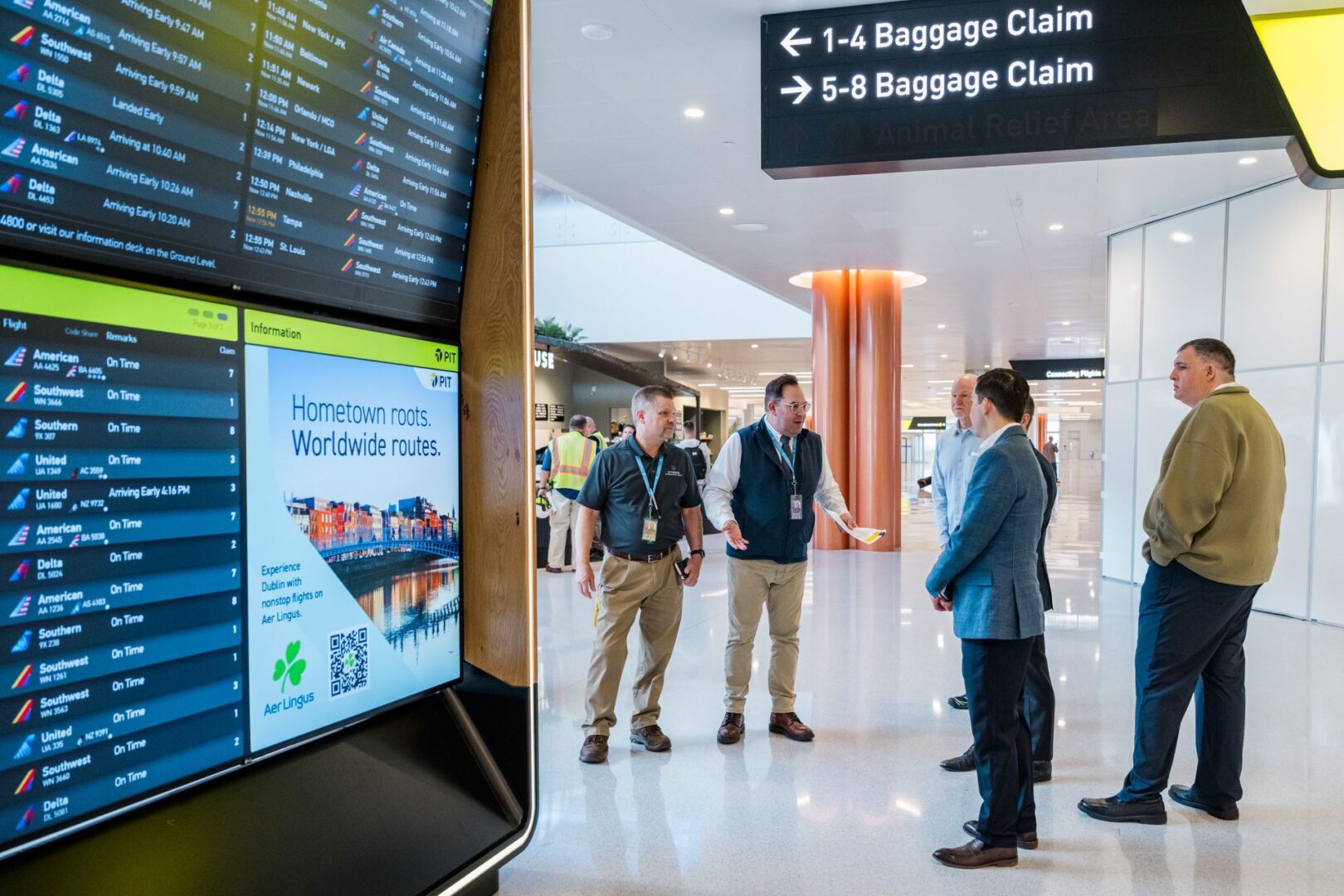
Officials from the Chicago Department of Aviation visited Pittsburgh International Airport last month to get a firsthand look at the new terminal – and to study PIT’s smooth transition from construction to public opening.
For the Chicago team – which oversees major airports like O’Hare International Airport (ORD) and Midway International Airport (MDW) – the visit provided valuable insights as it advances its own capital improvement programs. Officials noted that PIT’s integrated Operational Readiness and Transition (ORAT) model offered a replicable framework for reducing risk, improving efficiency, and delivering a smooth transition from construction to full operations.
The site visit kicked off with a terminal tour conducted by Tom Woodrow, PIT’s Senior Vice President of Engineering and Planning, and Communications Manager Rocco Pacella. After the tour, additional senior leaders at PIT and Daniel Bryan, of Jacobs, who the airport hired to implement ORAT principles, discussed various aspects of the overall program and how the airport implemented the ORAT process, what lessons were learned and recommendations for Chicago officials.
“Since we opened in November, we have had multiple requests for tours and information sharing,” Woodrow said. “While airports may compete for routes and service, there is a strong commitment among industry leaders to share ideas, best practices, and lessons learned. That spirit of cooperation helps all airports operate more safely, efficiently and effectively while better serving the traveling public.”
Chicago officials were told that ORAT is too often treated as an afterthought. What PIT did was fundamentally different – it built operational readiness into the entire program.
The early integration of ORAT principles led to continuous collaboration among designers, contractors, airline partners, TSA, concessions and airport operations staff. Stakeholders were involved in iterative reviews of layouts, passenger flows and back-of-house functions – allowing potential issues to be identified and resolved in real time.
This proactive approach ensured that staff were trained, systems were tested, and all operational aspects were aligned well before the terminal’s opening. One of the most cited examples of ORAT was the execution of three public facing trials that stress-tested the new facilities including the IT systems, ticket counters, TSA checkpoint, vertical circulation and the baggage handling system. Each of the three trials advanced in complexity until the third and final trial, which was a full-scale dress rehearsal featuring more than 1,800 volunteers from the community that were able to simulate the entire process of departing and arriving at the new terminal.
Zach Baughman, Managing Deputy Commissioner of the Chicago Department of Aviation was impressed with the new terminal and its best-in-class features. He said pictures and news stories do not provide an adequate representation. He wanted to learn first-hand about PIT’s experience, something he and his group could only get with face-to-face interaction.
“Throughout the industry, Pittsburgh’s terminal was widely recognized as a successful opening and we wanted to learn from their success,” Baughman said. “Access to (PIT’s) knowledge is invaluable. It was great to hear about what we should be thinking about in Chicago as we move into construction. Also, is there a blind spot that we are potentially missing that PIT could point out?”